
The argument for drones is pretty much the same argument as for any of the new smart weapon systems. Less people killed, the right people killed. Not pretty, but makes perfect sense; better to snipe, than to blindly shotgun everything with your fingers crossed. Very surgical, like Dr. House with a kalashnikov, shooting cancer, unconventional - but great TV. Or "Wall-e goes to Iraq" maybe. Oh, hang on, Wall-e has already gone to Iraq.
Well, that saved me half-an-hour on photoshop. Thank you internet.
On
the small-scale, perfect-world end - clear legitimate target, perfect
deployment - would seem as ethical as hell. Press-button,
destroy evil-doer - easy as a credit-card swipe at the mall, except you
don't take home new shoes.
But on the big scale, with a quick squint around the corner of the future, drone-armies are bad news.
But first.
Imagine there is a fat kid. I mean fucking huge. Blimplike in dimension. Put a gondola on that mother and fly him to Europe. But fat kid's trying, he's watching what he eats, trying to reduce the titanic arsenal of food he's got stashed in the fridge, by erm, not buying it rather than eating it. Get slim, save money. Future's rosey. Throw the gondola away, all transatlantic flights cancelled.
I come along. Give him a big smile. Bring in a big ole box. It's the Cheapsnax 3000™ food-dispener unit. Sits comfortably by the fridge - hell the deluxé version follows you around the house - don't even have to get off the sofa - primo smart-snax technology. Your ideal hunger solution - auto-clean function to tidy up collateral-crumb spillage. Assorted pastel colours, interior-decorator approved. Comes with auto-stock support function - you need never actually buy your own food again, no more painful waddles to the mall, consume endlessly from the comfort of your own home.
Unethical..? I mean, I haven't put a gun to his head or anything. He doesn't have to abuse it. I mean, if used wisely, it could save him time and money. If he explodes all over his appartment 6 months later it ain't nothing to do with me.
I was talking this over with a mate at work, first thing he said was "Whoo, cool, but expensive." But - Let's look at some figures.
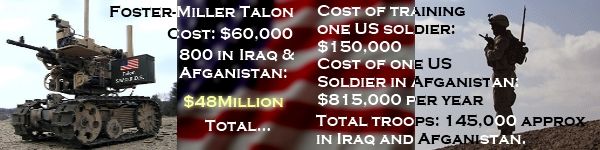
Not expensive. Roughly half as cheap to make at first glance. But look deeper, and the advantages of drone-soldiers to flesh soldiers are endless. Humans are badly suited to war. Don't need to grow a drone over a 20 year period. Turn 'em out by the 1000, week in, week out. Don't need to send them to boot camp. Downloading in progress. Don't get post traumatic stress disorder. Don't need paying, nor a pension.
Make them modular. If one gets immobilized, it doesn't sit there crying for its lost legs and bleeding all over the place. It becomes a sentry, patiently pot-shotting targets till it runs out of ammo. Then it becomes a stationary mine. Blows up if you come too close. Gps locator chips means it can be found even if rendered completely inoperable. Use the modules left to rebuild other drones. Plug and play. Kill a flesh soldier and he's 100% dead. Wound one and he's a burden on his comrades, even better. RPG a drone and maybe you'll kill it only 20% dead. And it goes right on trucking.
And ammo. Humans are shit at killing other humans. Let's ask statisticians.
Wow. Just Wow. 5.56mm bullet manufacture and cleanup costs http://ecomass.com/pdf/bullet.pdf. Green bullets, who knew..?
Drone-soldier however, could do better. Maybe not one shot one kill, not initially anyway. But it's a software/hardware problem, and problems get solved. The two big advantages here are:
(1) Scalability. With humans, you have to train each individually. Like making chairs for a living. You make a chair, you sell it. You make another chair, you sell it. You make one more, you sell it too. Write a drone trainer computer program however... Write it once, upload it a bazillion times while you sit back and throw cigar-butts at the chair-maker.
(2) Lack of conflict between orders and instinct. There's a joke. The bare bones are - General sends soldier into room with gun. Tells soldier to kill occupant as test of loyalty. [Gun fires blanks btw. it's only a psych test]. First two refuse. Last one comes out [he's usually of comical ethnic descent - Irish or something] breathing heavily. General says "Wtf..?" Last guy says "Well sir, the gun shot blanks so I had to kill them with a chair..."
Hilarity ensues.
Why's it funny though..? Someone died afterall. Died by chair even, one of the most horrible deaths of all. It's funny because humans have a natural aversion to killing other humans. Look at the propagandic lengths that are needed before killing strangers X,Y & Z begins to seem like a good idea, and the still further lengths required before the job gets done. There is always a war of public relations before the shooting version starts.
But drone boy..? Nah. Just upload new targetting details, insert ammo into hopper A.
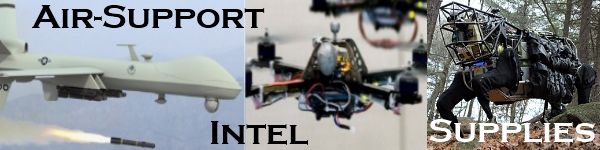
I could do this all day. But boiled down, drones, once out of their rather comical infancy, will become an automated war-package. Press button recieve bacon, erm, victory. The Cheapbang 3000™ Death-dispenser.
Is it unethical in itself..? On the scale of individual units and individual missions..? No, no more than an axe chopping trees. Is it unethical on a wider scale, given humanity's frailities in the face of temptation..? Hell yes. No more trees and squirrels crying on treestumps.

Why are wars, big or small, hard to start..? - Unless they are brought to your doorstep and you have zero choice..? Simple answer, soldiers have Mums. And Dads, and girlfriends and wives and children and brothers and sisters and second cousins twice removed. To send a son or daughter off to fight, and maybe die for the cause of country - Dulcé et decorum est, pro patria mori [thanks Seigfried] - that soldier's family has to be damn well convinced that the cause of country in question is beyond doubt. Communism has to be smelled, weapons of mass destruction located, oil supply has to be threatened. Oops, sorry, scratch the last one, never happen. [?Hmm-scratchbeard?]
But if all that's gonna be sent overseas is a bunch of metal and wires, and comparatively cheap bunches of metal and wires to boot, then erm, who cares..? That initial social resistance to deployment, to the commitment of forces, will be reduced to a small murmur of "Well, try not to spend too much cash guys okay..?" Military interventions will barely ripple the social surface tension. What's news-worthy about Maul-e™ unit two-six-six taking a tracer in the chest-plate and getting his paint-job scratched..?
Poeple would just get used to seeing the results of such actions, with near-zero human costs.
ie. casualties for any single skirmish may be lower with drones... More 'ethical'... But the total number of skirmishes would increase. And given our rates of energy consumption... Increase probably exponentially.
Next question of course, the other end of the equation, what stops wars..?
Well, economic-wise - attrition. Lack of matériel, lack of ammunition and other supplies, lack of soldiers to use them. But more often than not, in our modern age of limited warfare, it never comes down to the economic wire - long before that the public becomes increasingly outraged by the loss of life. Erm, the lives of their own soldiers anyway - fuck those other guys. Why else do the armed forces try to minimise casualties..? Leave no-man behind..? Because they care deeply about the welfare of their men..? Yes, that must be it. Nothing to do with trying frantically to eke out their dwindling supply of public support until they achieve their objectives. No, that would be deeply cynical and completely unlike me.
No one will mourn the loss of a drone in combat. It would be like mourning a toaster.
So then, once begun, why stop a drone-war..? Even if an objective is reached, a country subjugated. Why bring them home at all.? It costs big to occupy a country with conventional troops, but you could just park your drones around the map in armored bunkers, put them in sleep mode, and hang out the solar-panels - indefinitely. There's your veto-power right there and ready to go.
So - in short, wars, of the smaller Military/Industrial Complex type, driven by scarcity perhaps, will become waaaaay more common/acceptable to public opinion, and last a lot longer - grinding up more human lives in the process and manufacturing enemies as they go.
But on the big scale, with a quick squint around the corner of the future, drone-armies are bad news.
But first.
Imagine there is a fat kid. I mean fucking huge. Blimplike in dimension. Put a gondola on that mother and fly him to Europe. But fat kid's trying, he's watching what he eats, trying to reduce the titanic arsenal of food he's got stashed in the fridge, by erm, not buying it rather than eating it. Get slim, save money. Future's rosey. Throw the gondola away, all transatlantic flights cancelled.
I come along. Give him a big smile. Bring in a big ole box. It's the Cheapsnax 3000™ food-dispener unit. Sits comfortably by the fridge - hell the deluxé version follows you around the house - don't even have to get off the sofa - primo smart-snax technology. Your ideal hunger solution - auto-clean function to tidy up collateral-crumb spillage. Assorted pastel colours, interior-decorator approved. Comes with auto-stock support function - you need never actually buy your own food again, no more painful waddles to the mall, consume endlessly from the comfort of your own home.
Unethical..? I mean, I haven't put a gun to his head or anything. He doesn't have to abuse it. I mean, if used wisely, it could save him time and money. If he explodes all over his appartment 6 months later it ain't nothing to do with me.
I was talking this over with a mate at work, first thing he said was "Whoo, cool, but expensive." But - Let's look at some figures.
Not expensive. Roughly half as cheap to make at first glance. But look deeper, and the advantages of drone-soldiers to flesh soldiers are endless. Humans are badly suited to war. Don't need to grow a drone over a 20 year period. Turn 'em out by the 1000, week in, week out. Don't need to send them to boot camp. Downloading in progress. Don't get post traumatic stress disorder. Don't need paying, nor a pension.
Make them modular. If one gets immobilized, it doesn't sit there crying for its lost legs and bleeding all over the place. It becomes a sentry, patiently pot-shotting targets till it runs out of ammo. Then it becomes a stationary mine. Blows up if you come too close. Gps locator chips means it can be found even if rendered completely inoperable. Use the modules left to rebuild other drones. Plug and play. Kill a flesh soldier and he's 100% dead. Wound one and he's a burden on his comrades, even better. RPG a drone and maybe you'll kill it only 20% dead. And it goes right on trucking.
And ammo. Humans are shit at killing other humans. Let's ask statisticians.
In Vietnam, 50,000 rounds were used for each kill, a three-fold increase over WWII levels.
There is an amazing (and startling) statistic out of Iraq and Afghanistan: the United States has fired an estimated 250,000 bullets for every insurgent killed. [source: reddit]
Wow. Just Wow. 5.56mm bullet manufacture and cleanup costs http://ecomass.com/pdf/bullet.pdf. Green bullets, who knew..?
Drone-soldier however, could do better. Maybe not one shot one kill, not initially anyway. But it's a software/hardware problem, and problems get solved. The two big advantages here are:
(1) Scalability. With humans, you have to train each individually. Like making chairs for a living. You make a chair, you sell it. You make another chair, you sell it. You make one more, you sell it too. Write a drone trainer computer program however... Write it once, upload it a bazillion times while you sit back and throw cigar-butts at the chair-maker.
(2) Lack of conflict between orders and instinct. There's a joke. The bare bones are - General sends soldier into room with gun. Tells soldier to kill occupant as test of loyalty. [Gun fires blanks btw. it's only a psych test]. First two refuse. Last one comes out [he's usually of comical ethnic descent - Irish or something] breathing heavily. General says "Wtf..?" Last guy says "Well sir, the gun shot blanks so I had to kill them with a chair..."
Hilarity ensues.
Why's it funny though..? Someone died afterall. Died by chair even, one of the most horrible deaths of all. It's funny because humans have a natural aversion to killing other humans. Look at the propagandic lengths that are needed before killing strangers X,Y & Z begins to seem like a good idea, and the still further lengths required before the job gets done. There is always a war of public relations before the shooting version starts.
But drone boy..? Nah. Just upload new targetting details, insert ammo into hopper A.
I could do this all day. But boiled down, drones, once out of their rather comical infancy, will become an automated war-package. Press button recieve bacon, erm, victory. The Cheapbang 3000™ Death-dispenser.
Is it unethical in itself..? On the scale of individual units and individual missions..? No, no more than an axe chopping trees. Is it unethical on a wider scale, given humanity's frailities in the face of temptation..? Hell yes. No more trees and squirrels crying on treestumps.
Why are wars, big or small, hard to start..? - Unless they are brought to your doorstep and you have zero choice..? Simple answer, soldiers have Mums. And Dads, and girlfriends and wives and children and brothers and sisters and second cousins twice removed. To send a son or daughter off to fight, and maybe die for the cause of country - Dulcé et decorum est, pro patria mori [thanks Seigfried] - that soldier's family has to be damn well convinced that the cause of country in question is beyond doubt. Communism has to be smelled, weapons of mass destruction located, oil supply has to be threatened. Oops, sorry, scratch the last one, never happen. [?Hmm-scratchbeard?]
But if all that's gonna be sent overseas is a bunch of metal and wires, and comparatively cheap bunches of metal and wires to boot, then erm, who cares..? That initial social resistance to deployment, to the commitment of forces, will be reduced to a small murmur of "Well, try not to spend too much cash guys okay..?" Military interventions will barely ripple the social surface tension. What's news-worthy about Maul-e™ unit two-six-six taking a tracer in the chest-plate and getting his paint-job scratched..?
Poeple would just get used to seeing the results of such actions, with near-zero human costs.
ie. casualties for any single skirmish may be lower with drones... More 'ethical'... But the total number of skirmishes would increase. And given our rates of energy consumption... Increase probably exponentially.
Next question of course, the other end of the equation, what stops wars..?
Well, economic-wise - attrition. Lack of matériel, lack of ammunition and other supplies, lack of soldiers to use them. But more often than not, in our modern age of limited warfare, it never comes down to the economic wire - long before that the public becomes increasingly outraged by the loss of life. Erm, the lives of their own soldiers anyway - fuck those other guys. Why else do the armed forces try to minimise casualties..? Leave no-man behind..? Because they care deeply about the welfare of their men..? Yes, that must be it. Nothing to do with trying frantically to eke out their dwindling supply of public support until they achieve their objectives. No, that would be deeply cynical and completely unlike me.
No one will mourn the loss of a drone in combat. It would be like mourning a toaster.
So then, once begun, why stop a drone-war..? Even if an objective is reached, a country subjugated. Why bring them home at all.? It costs big to occupy a country with conventional troops, but you could just park your drones around the map in armored bunkers, put them in sleep mode, and hang out the solar-panels - indefinitely. There's your veto-power right there and ready to go.
So - in short, wars, of the smaller Military/Industrial Complex type, driven by scarcity perhaps, will become waaaaay more common/acceptable to public opinion, and last a lot longer - grinding up more human lives in the process and manufacturing enemies as they go.
















 Notes on the Black Swan by Nassim N. Taleb: