Showing posts with label neurophysiology. Show all posts

Monday, January 31, 2011

Decisions Decisions.

A quick and dirty neurophys-summary on high-function decision making:

The prefrontal cortex is the outermost layer of the frontal lobes - the bit just above and behind your eyes - the bit that most noticibly separates us from neanderthals and chimps. When the docs started chopping bits out of it back in the 50's in the name of psychiatric science - to calm down 'neurotic women' - side-effects varied between death, and catatonia in rare cases and an almost universal severe impairment of short-term memory and an inability to control impulses.

Put into simple terms, people with prefrontal problems become 'external stimulus biased' ie, you give them a comb, and whatever you might tell them to do with it, they'll comb their hair. Show them food, they'll imediately begin to eat. Make them angry - they fight. They see, they do, without intermediary deliberation. They're great at parties.

The PFL works in three ways.

Wednesday, December 01, 2010

The Brain that Talked to Itself.

I was talking with a friend the other day about language and thinking, and how the brain does it. He said, quite emphatically:

 "brain chemistry must have something in it that represents a statement in a linguistic way"

And I was pretty much tsaying that it doesn't.

Not as he imagined anyway.

Linguistic representation is to the brain is as sky-writing in a plane is to us. Effortful, showy, slow, and kinda dumb. Imagine Shakespeare writing all his plays with the aid of a funky single-prop plane.

First, let's talk about speed. I'm just gonna write "I want to go to town and get a pizza" on a bit of paper. Okay, it took me 14 seconds. Now, I'm gonna type it. i want to go to town and get a pizza. I cheated a bit with the capitals. Still it took 10 seconds. I am only a three-and-a-half finger typist however, I imagine their are faster typers out there.

Now, I'm going to risk a few weird looks and say it out loud, at a normal conversational pace. Took about 2 seconds. And one weird look. Now I'm going to say it as fast as I can. awannagotatownangettapizza. About a second. Now I'm gonna think it.

That's where it gets tricky. If I simply mentally speak it, it takes the same time as the speakasfastasican version. Which is no surprise as the systems are the same, except during 'speech thinking' your brain simply supresses the movements of your tongue and mouth. However, if I don't really try to 'say' it seems just to hover there whole. Taking no time that I can measure on my watch anyway.

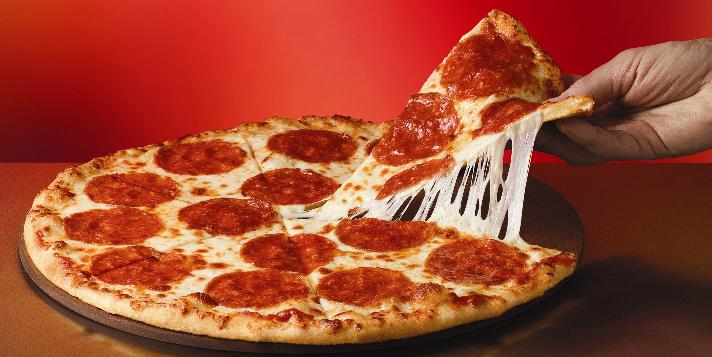
Quick. Imagine a pizza.

Monday, September 20, 2010

Free-Will. Two Men & A Bear.

Funny how inspiration strikes sometimes. I was sitting on the balcony thinking about the debate with a friend, and about free-will. And that old joke about the two guys running from a bear popped into my head. You know the one - one guys says "Shit, we gotta outrun that bear." and the other guy says "Nah, I just gotta outrun you..."
And for some reason, something clicked.

We experience having free-will, and yet it seems to contradict everything else we observe. Something aloof from the usual clunk-clunk cause-effect universe.

If I were better at computers, I'd have produced a wonderful simulation to illustrate this next bit, but unfortunately, I'm not, so we'll have to do with imagination. Imagine a board, a bit like a chessboard, but bigger perhaps.

In the middle is a cafe. The cafe makes and serves only two kinds of food, blue food, and pink food. Dotted around the edges of the board are the homes of blue and pink people. They stay in their homes until they get hungry. Each get hungry at specific times, on utterly clockwork cycles, three times a day. When they get hungry, they move at a rate of one square a second, along the shortest path between their home, and the cafe. The blue people eat blue food, the pink people eat pink food. That's all they ever eat. After they've eaten, they go home, retracing their paths, to await the occasion of their next hungry cycle.

The chef in the cafe, knowing what they will eat, when they will eat it, and the exact times that each will appear in the cafe, buys stocks and prepares it accordingly, there is no lack, no waste, the food is always hot and ready as soon as the patrons sit at the tables.

It is a very simple simulation. No variables, no random factors. It runs faultlessly, automatically, day in, day out. The chef knows exactly what will happen at any given time, however far in the future that time may be. The system is utterly predictable, each node in constant lockstep with all the rest. Determined. There is no free will - no choice for the people to restrain or pre-empt their hunger, no choice of what route they will take, no choice of what they will eat. They make no choices, they also know exactly what they will be doing at any given time.

Obviously - this 'bears' no resemblance to reality. [Bears geddit..? Arf.]

Let's shake it up a little. Now the Pink people eat blue food, but only on Tuesdays, and the blue people, if it's a Thursday, eat pink. But it's too simple, the chef still is able to predict and plan to cater perfectly for his clientelle. Still a determined system.

Again, we'll add complexity. They go for haircuts on specific times every month, again, predictably and in an utterly clockwork fashion. The length of their hair affects what they can eat - short and they switch preferences until it grows past a specific length. Again, now if there are more right turns than left as they move across the board from their homes to the cafe they switch preference from the one dictated by day, or hair length. And again, if they are preceded by two people of the same colour, they switch from their previous preference.

Okay, now the situation is a lot more complex, I couldn't work it out straight off the cuff, but still the system is determined - the computer can run it perfectly. The chef buys his produce, cooks it serves it, no mess no fuss no waste.

The point I'm trying to make is that as long as the behaviour and preferences of the people living on the board are known explicitly, are predictable by the chef, the system is inarguably determined, and there is no question of choice involved on the parts of the pink and blue people.

Here's where the two guys and the bear come in. Except this time one of the guys is the conscious experience of free-will, and the other is autonomic prediciton, determinism. The bear, well hell, the bear's kind of extraneous, so he can still be a bear.

And to complicate matters, both these guys are running inside of one head. Your head. You have two guys and a bear in your head. Okay..? Also might help to view your brain as a great big prediction engine.

So, now imagine the head of a pink person. Which guy is running ahead of the other..?

Well, prediction of course. Prediction looks at his watch, remembers the time he was last hungry, works out when he will be next hungry, remembers the path he takes to the cafe, the turns it takes, the time it takes, knows what day it is, checks the length of his hair, knows his colour... And knows absolutely what he will being doing at any point in his future. Each moment, each action, flows seemlessly into the next like clockwork.


The experience of choice, the experience of free-will, is eaten by the bear.

But the brain, this marvellous prediction engine we all carry within the confines of our skulls, is only so big. Prediciton can only run so fast. If the number of states, the number of variables it has to deal with during predicitive acts goes over a certain [and pretty small really] limit, poor old prediction starts to stumble, starts to run out of breath.

And I think, that is when the experience of free-will, of choice, of being able to have chosen a different food to the one we find ourselves eating, begins to overtake. The chef drops his wok, fucks up his shopping list and starts swearing at the staff. Now it's prediction's turn to feel bear-nibble.

Did you know you are effectively blind for around forty minutes of each day..? It's called Saccadic masking. Basically, to prevent your world from looking like the jerky camcorder movie all day, your brain shuts down your optic nerve while your eye is in motion.

I have a feeling that our experience of deliberation, leading to the experience of having made a chioce, of free-will, is similar. A masking process, to cover the periods in time when our (unconscious) predictive engines get their cogs in a twist and can't get up sufficient momentum to whip us across from one action to the next.

When we walk, or climb stairs, we have no consciousness of having chosen where to put our feet. It takes a minefield, or a tango class to wake us up to what we're doing. It takes complexity, processing lag, to wake us up.

We observe, albeit with a few quantum quirks, an utterly deterministic universe. We ourselves are made of matter, our thoughts are generated and supported by physical sysytems. Our systems of meaning, of relating or associating thoughts and thought images are also deeply emeshed in the physical world, and are laid down according to experience in the physical world, in relation to physically limited parameters of chemical and electromagnetic brain function. There is no magic lurking in our synapses. No get out of jail-free cards.

I think what we experience as free-will, of choice, is simply a kind of papering over of the cracks, akin to a sort of maintained cycle of surprise - the brain locked in a state of not knowing wtf. is going to happen next.

That said however, the illusion of free-will, if indeed it is illusion is a damn convincing one.

Part of the experience of having free-will - of choosing - is the existence of multiple alternate futures we could have chosen from. In one future, I chose the fish, in another I chose the steak, in yet another I said "fuck this" and walked out. All seem to have hovered before our eyes, equally choosable at that moment of choice. Why would these ghosts of future possibles haunt me so, if there is no such thing as freedom of choice..?

Next slide please:

Image

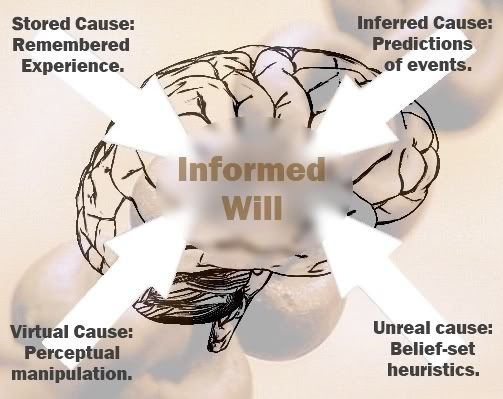
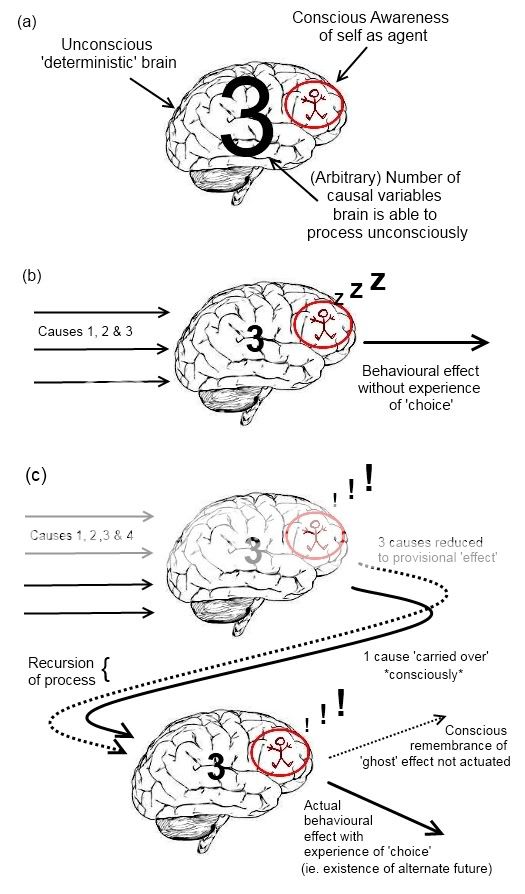
Obviously this model is woefully simple and doesn't indicate that all causatives are not external - there are a great number of internally-generated causatives or 'wants' - hunger for one, as exemplified in the original post. But it does emphasize the recursive/reductive processing the brain is forced into doing by the limits of its processing power.

The aforementioned wants and other drives that we experience are the condensed reductions of a myriad of other lesser causatives generated by the body - when we experience hunger we are not aware of the individual detail - PH of stomach, blood-sugar concentrations, the hormonal tides of circadian rhythms etc. etc. etc. - we simply feel 'hungry'. The brain has helpfully simplified the inputs from the body systems into a single imperative.

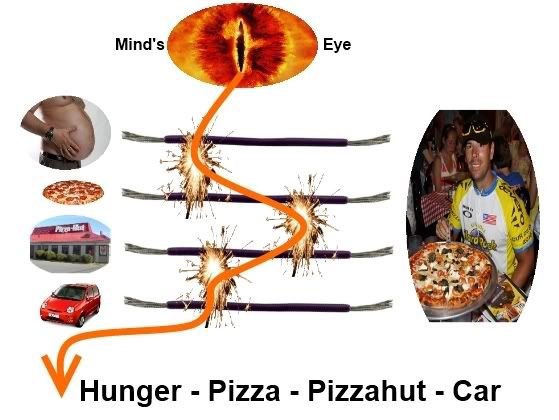
Getting back to the diagram, you must extrapolate the numbers of recursions our brain-states undertake when faced with difficult high-variable situations - generating multiples of alternate futures, which in turn are then re-considered - becoming virtual causatives in turn - and plowed back into the heuristics our brains use for reducing effect-clusters into behavioural imperatives - forcing action.

But I'm getting technical, which is always a bad sign. In short, we experience as part of the process of determined causal reduction - deliberation/choice - sometimes a myriad of alternate futures. But that does not mean we are as free as we think to act upon them.

I think it's about time to dredge out the classic Socratic "He who knows what is right will do right" there are of course many interpretations of this quote but to me, the implication of not being able to undertake an action deemed as 'wrong' has always been apparant. Put into cognitive terms: The brain seeks the 'right action' in response to a set of external and internal causative variables.

And once it alights upon what it defines as 'right action' undertakes that right action - this is the important bit - and no other.

The alternates we are aware of as we seem to choose are merely ghosts, never to have been realized - not ends in themselves, but simply parts of the process.

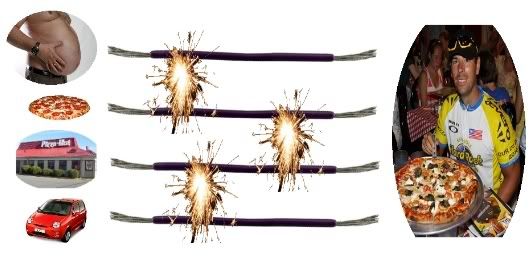
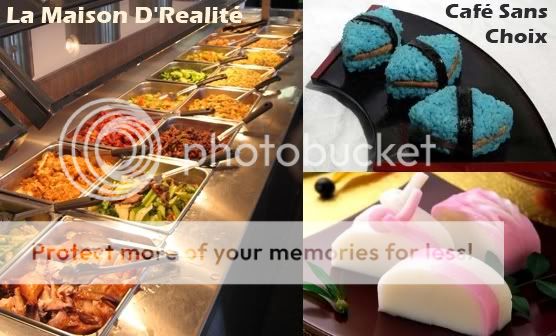
Another pillar supporting the notion of free-will and meaningful choice is external to the individual rather than hidden coiled and invisible within the crenulations of the brain. We in the world have surrounded ourselves by choice. The open buffét of real life...

Image

...is a long way from the deterministic Café's blue food/pink food combo. Why so much choice if there is no free will..? I mean, it's one thing to fool ourselves, but a wholly other thing to fool the world.

It comes down to prediction once again. Remember the chef in the BluePink café..? How easy he had it, with his utterly predictable clientelle..? No mess, no fuss..? What would have happened if he'd launched a menu of orange food..? Well, it would have just rotted on the plates, untouched, un-ordered.

Trouble is, when it gets to the point where not only can you not predict the actions of others, but cannot even predict what you yourself will do from moment to moment with anything like total accuracy... Then making orange food doesn't seem so foolish.

Whether choice and the ability to choose is real or not, it doesn't matter. Illusion and reality aside - choice begets choice. The chef, faced with an unpredictable range of punters, is drawn to follow the path of making best guesses. Creating a broader range of food, following a bell-curve diversity of stuff he's come to observe everyone likes, quite a few people like, what's in vogue right now, what's in season right now, what's cheap and what's expensive right now. He also, like a speculative investor, will try to create a new menu option from time to time - a long-shot. I dunno - fried ice-cream or something.

Some of these long-shots will pay off, becoming subsumed within the great collective cuisine of the masses, others will be spat out, and get struck off the menu. But always the number of choices made available will grow. It will be the same in any industry - fashion, automotive etc. etc. Ford's classic "you can have any colour as long as it's black" never lasts. In attempting to cater for a range of tastes beyond his capability to predict accurately, the great chef will always err on the side of too much, rather than not enough, or be out-competed by the fancy restaurant next door.

This last point is of dubious importance. It has to do with the idea of "shaping".

In the orignal model - the board-game world of predictable blue and pink people - the chef, because of his perfect knowledge of his patrons, was able to 'shape' himself to them. By this I mean he could perform his job so well as to become invisible to the person visiting his cafe. They would come in and the right food, at the right temperature, would have been placed on the table only seconds before their hand had alighted upon the handle of the cafe door. The need for interaction between the workings of the cafe, and the punter, drop to zero if prediction is total and accurate.

Now imagine a world that could predict you absolutely, and naturally shape its machinations around you, one that you could subconsciously predict perfectly yourself. Need you be conscious at all..? Would anything actually require your attention..? Or active involvement..?  All would in effect, be one indivisible system, and would have always been one.

In short, I have a feeling that consciousness, our sense of individuality, and imperfect prediciton are very closely involved.

Monday, March 09, 2009

The Ducks of Meaning.

Hmm. Hokay, I want to try to describe how 'meaning' can be ascribed to a physical point located on a neural network. There is nothing special about the particular neurons there, they are all indistinguishable to the eye. They don't have "Hi I'm your concept of fashion" tattooed on their membranes. So why does one neurone-body mean "affable" and another mean "snot"..?

I want you to imagine a pool of still, unrippled water. The edge of the pool is populated by specially trained ducks. Each has a pebble to push in with its beak. They all have electrodes wired to their butts. All these wires coil away into the back of our volunteer for the evening - Bill's - head. Each wire is connected to parts of Bill's sensory sytems - His visual centre, his tactile centre etc. A very cute nurse is handing things to Bill for him to percieve, and every once in a while wiggling her hips for no reason in particular. Let's call her Miranda. And make her a blonde-bombshell.
...Continued...

Sunday, March 08, 2009

The Carrier and the Content.

AMOEBA, another marvel of engineering, but this time one not aspiring toward being alive. Now we can write our names upon the water, and not be overly Keatsian about it. Anyway. What is this doing here..? Well, it illustrates my ideas about the carrier and the content very well.

In the last post I talked about a TV:
"None of the components of a TV are individually alive. But, together, in orchestra, they support a picture, a story, the content of which has very little to do with the mechanics of the device supporting it."
But this device - comprising about 50 small wave generators acting on a common medium to form a standing wave of meaningful content - acts as a much better analogy to our own situation.
...Continued...