
Down drown
dismal and frown
caper mothlike
round and round
flying to sizzle
wing-pop and frizzle
no big bad storm
not even a drizzle
to mark the deadend
of an inglorious life
bound round by children,
hard work and a wife.
Lies lies
in loving disguise
whispered to hush
our little-one's cries
no ghouls in the cupboard
or under the bed
And Auntie Jean didn't
eat Uncle fred's head
(her legs in the air and the
whole bedstead rocking)
that time when they saw
her all bra-strap and stocking.
Dazed hazed
exhausted malaised
sleeping so little
you're patently crazed
forgiven perhaps
the odd little faux-pas:
the pants full of crap
the dent in the car
So childish so shackled
so green eggs and ham
please somebody shoot me
dead dog that I am.
Tuesday, May 01, 2007

Sunday, April 29, 2007
Stripping away Society
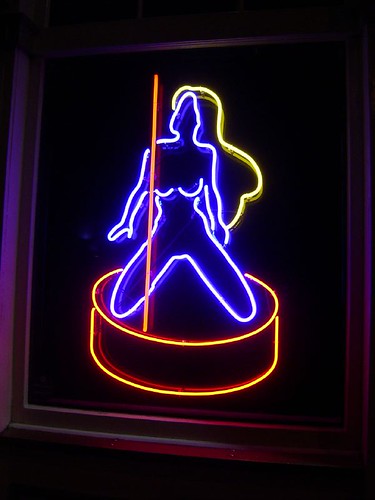 I've been to a couple of strip clubs, both openly in Amsterdam and on the sleazy underground scene in the UK, and I was always left wondering at what a bizzare ritual it is, beneath the visible surface of "Whoo - Hot chick getting dirty."
As flatly as possible: In the UK I went last to a semi-legal Stripper's night at a Working men's club, hidden away on the outskirts of Nottingham. Large basement club, probably a dancehall in its better days, filled with pissed middle-aged workmen served by middle-aged topless waitresses who had all seen much, much better days. Three strippers came on, and proceeded to strip with all the eroticism of a mechanic taking off his dirty overalls after a hard day at the garage. After a lot of squatting and the inserting of various household fruits the threesome pulled some poor sod out of the crowd, tied him to a chair, cut off his clothes, laughed at his admittedly short and frightened dick, and then with the help of some of his colleagues carried him out and dumped him naked on the street. Then they walked about, still nude, with pint glasses to collect tips from the strangely subdued and silent audience. I gave her a pound coin, which was enough to elicit a small shrug and a wobble.
In the red light district of Amsterdam we were ushered up some stairs into a large space and packed bizzarely into old church pews set back on tiers, like an old amphitheatre, from a small dark stage. No entrance fee, but exhorbitantly-priced (and manditory) drinks. The first act came on naked, selected a willing volunteer and stripped off his shirt. She shaved a small bare patch on his chest, then, inserting a marker pen into her vagina, she wrote "I love you" across his pecs in a fair copperplate hand, or rather pussy. The second act was a small Asian woman in a towel, and a big fat naked guy sitting in a deck chair reading a newspaper. After some amateur acting they got down to business doggystyle, with great concentration on the part of the guy, and some cavernous stage-yawns from the lady. the third and final act was a chubby, vivacious and rather petite blonde, whose party piece was to insert a banana, squat and arch herself way off the stage and invite people to take a nibble.
Well worth a couple of watery and overpriced beers, but more freak-show than sex-show.
But why does stripping exist at all..? I mean, go ask any little girl in school what she wants to be when she grows up... "Please Miss, I wanna be a stripper." Is going to fall pretty low on the list. Does anyone really choose to be a stripper..?
Let's talk about egg-boxes for a while. And social topography: Say I put down a whole lot of empty egg-boxes down on the floor and then start chucking ping-pong balls at them. (You can do this at home folks). Anyway, they may bounce around a bit but soon they'll settle - Where will they sit..? That's right - in the holes. Why..? Because that's the easiest, most stable place to rest.
Not impressed..? You should be. Did the balls create the landscape..? Could they have chosen to settle anywhere but in the holes..? No and no. Their behaviour was dictated to them by forces outside of their control.
This principle works on any scale: The Universal laws of physics dictate what kind of matter can exist, in what forms. Matter, and the interactions its nature allows between the differing types, dictate the formation of enviroments. Enviromental conditions dictate wether or not life is possible, and if so, the forms of life that can live there. The requirements that a lifeform must fulfil in order to maintain itself, its needs, dictate the way in which it lives. Its society. Only at this very end point do the capabilities and properties of the individual, together with great big chunks of random luck, dictate the position that individual will occupy within that society.
So far, all these stages have been physical topographies. But once a society of thinking beings has been created, that society creates yet another topography wholly of itself, another egg-box.
Back to our experiment - Okay, so by now I've chucked in enough ping-pong balls so that almost all of the holes are filled. But I still have a bucketful of balls left. I throw some more on, now where do they rest..? Easy - they come to rest supported on the shoulders of their brothers: The 'Underballs'. These new 'Overballs' have found new positions of stability that did not exist before the lower strata of ping-pong society was formed. They 'prey' if you like upon the lower balls, and rather than working directly to support themselves, derive a living by offering an 'unnecessary' but desired service to those members of the ping-pong society that are willing to support them.
But basically, everyone born, needs a hole. And when there are enough people to fill all the nice, respectable holes... Then people start choosing from the lesser degrees of many evils. Men like to look at naked women. People need money... You don't need to be Nostradamus.
ie: We may not be able to predict exactly which individual will suddenly stick on the pasties and start putting scissor-locks on a poor, innocent pole under a hot spotlight, but we can predict with absolute certainty that someone will. Strippers, like hitmen and sewage disposal workers, are inevitable. There is nothing ethical or unethical about it, no-one to blame, unless you want to blame E=mC2, or the laws of thermodynamics.
So, now we have a basic concept of stage; audience; woman taking off clothes. Simple. But what real purpose does it serve..?
For a start, it's not an exercise in sexual relief or gratification for the audience - it's a exercise in frustration. It's a crazy concept. Imagine you are thirsty, you walk into a shop licenced to sell miscellaneous beverages. You pay your money and this sleek, curvaceous bottle of cool water bounces out onto a small stage and, after some rythmic gyrations, coyly removes it's cap. It stretches and contorts, flashes a bit of open neck - maybe sprinkles a few drops of raw H2O on your face - and suddenly you're gasping, your throat's constricted, dry as a whistle - you'd be sweating like a pig if you had any moisture left in your body to spare - trembling, you reach out to grasp it, drink it...
...And some huge bouncer jumps out from behind a curtain and beats you to a pulp.
So now you're bloody, beaten, poorer, and even more thirsty than you were when you first went in. Then you do it again. This time maybe tucking a few more precious Dollars under the dancing bottle's plastic ring for good measure. Or perhaps saving up your cash for that really exotic foreign water from the darkest reaches of the Ivory coast that you saw advertized last time.
Fun..? Duh. Madness.
Still - Naked women dancing about. Men sitting around like lemons with hard-ons. No harm done. Trouble is it never just stays like that. Strippers, whilst they may comfort themselves that they are exploiting the hormones of any singular spectator, are still bound into the role of having to please the audience en massé to earn their daily bread. The trouble comes when the industry starts to compete with itself to first meet, then anticipate the desires of its audience for flesh.
A quick flash becomes blatent full frontal. Full frontal becomes spread wide. See how much can I cram in there. Full sex. Watch the dog. The horse. Whoops, I just peed myself. Shit myself. Tie me up and stick needles through my thighs till I cry. Hurt me. Beat me. Burn me. Kill me..?
Don't kid yourself, it happens. For every drop-dead gorgeous stripper there are a hundred so-so ones, and for each one of those there are a hundred more real boilers. Of those boilers there'll always be a couple so desperate that they're prepared to do some really awful stuff to make ends meet. And equally there will always be some people jaded enough, bored enough, or simply just fucked up enough, as to want to see them do it.
Curiousity creates availability. Availibility encourages demand. For anything. As a race, we're bored. Don't believe me..? Let me tell you a story:
Winter of 2006 I was in a Bus crash. The bus I was travelling on to work hit a woman crossing the road and splashed her brains out all over the asphalt. She had been carrying her shopping and there was food scattered all about her corpse. Crushed chicken was mixed in with her brain tissue. Her long skirt was up over her thin white thighs and her jumper was rucked up under her breasts revealing her untanned midriff. This was a devout muslim woman who'd been wearing a headscarf, normally you would never even see her ankles.
We were sat there until the traffic police came about twenty minutes later. No-one covered the corpse. People with mobile-phones got off the bus and took pictures. People grumbled about the delay. Cars slowed down to rubberneck. One person said "Don't look, it is shameful." She was ignored.
Labels:
social commentary
Thursday, March 29, 2007
Nobody loves a Hooker..?

Prostitutes are bad, apparantly. Those lingerie-touting floozies - Fulfilling a basic human need, for money. Disgusting. Awful. Shameful. Makers of Spam hang your heads. Ice-cream salesmen, whip yourselves raw you despicable sinners.
So, who dilineated these distinctions of "Good-Woman" "Bad-Woman", the whore and the virgin..? Hmm..? Men never cared. We'll take a Tart-with-a-heart over a frigid ice-queen if push comes to shove. We ain't all that choosey. Who do we want..? I can wash up and Hoover for myself thank you. Someone marry me to a stripper with her own collection of novelty pasties. I'll pass on the plaid-skirted wall-flower thank you. Only a man unconfident of himself will worry too much about his woman's profession leading her to infidelity. (But then, in some areas, men are always unconfident).
Jealousy. Envy of those who flaunt their beauty. Hatred of those with ample wiles to entwine the hearts of men. The hatred of women for women. That is what spawned these words and their emotional baggage. It is the bane of women that they cannot all be beautiful.
If men in general naturally despised a whore as much as women do - The profession would not exist. And yet it remains the oldest. Every city has its red-light, however hidden. Every little boy has his stash under the bed.
Whatever the less than perfect, or even downright ugly, reality - The whore in the abstract is the epitomy of sexuality - A siren tempting sailors onto the rocks - Er... To get their rocks off. Intriguing, irresistable. Honest.
All women who have wiles, use them. At the bottom of any particular wile is the implication "Do this for me, man, give me that, man, grant me this favour, man... And I'll hitch up my skirts for you." It matters not wether it is Brittany Spears writhing half-clad on a pole in a video, or blousey Mrs Spoonsbery smiling at the teaboy when she hasn't quite got enough small-change for a cuppa. It is the same. An implicit sexual transaction is made. They are so common, so everyday we don't even notice them anymore.
A prostitute's only real crime in the eyes of her fellow women is to actually go through with the deal. A one off quick-fix, at a bargain price.
And so the profession must be cheapened, despised, and those men who go voluntarily into a prostitutes' so-willing arms must also be castigated, heckled, brought low in the eyes of society.
Women have taught man to hate a whore. To compete, they had to. She is the enemy, the fifth columnist - She that offers womankind's most obvious bargaining-chip so cheaply, so free of conditions. And men, dogs that they are, pay that hatred lip-service, in the hopes of getting some lip-service.
Labels:
social commentary
Tuesday, January 30, 2007
Behaviour and Consciousness.

Part 1: The Great Schoolhouse of Life.
If you rap the tip of your cane smartly upon the blackboard of reality - knocking it just a little askew - And then cast a beady, bespectacled eye across the haze of quantum chalk-dust resulting you will see that the vista so revealed resembles nothing less than a classroom and life naught but a mass of pimpled youth, fresh off the bus.
Let the lesson begin - Sit up straight - Can you hear me at the back there..?
First up - We're not talking outright physical modification here - but strictly behaviour and idea.
Some definitions:
Bottom-Up - This is a 'true' learning network, its behavioural/cognitive pathways largely undifferentiated, a blank slate, ready for its individual connections to be strengthened/depleted as active back propagation or simple use boosts them, or lack of use causes atrophy, according to the judged success of each 'run' through the (neural/computational) network. Think baby learning to talk, or chimp picking ants out of a log with a stick. Fuzzy, loopy, round-a-bout.
Top-Down - This is an inflexible, sequential 'list' of behaviours governing some activity - written in stone - There is no learning involved, no adaptive change in process in response to external forces. Think a ticker-tape program on one of those old house-sized computers. Or a bee puking up wax to make cells for larvae. Linear, straight, unswerving.
Sense: A halfway house between out and in, a conduit - One must remember that an eye cannot 'see', and an ear cannot 'hear' - Both hearing and seeing are processes of interpretation and contextualization with prior experiences, carried out by neural tissue. The eye is blind, the ear deaf. Indeed, recent experiments with blindness have shown that those with no normal avenues of vision can be quickly trained to 'see' with the help of a camera attached to a stimulatory device which is placed on the tongue. It seems that what we term as our senses are really just organs which facilitate the highest resolution of sensation for the patterns of sensory data in question - the lens and the retina work to provide a high resolution/bandwidth of data which the brain 'recognizes' as visual data and so processes in the visual centres. It seems that the crucial factor is not the avenue by which information 'enters' the brain, but the actual properties of the information itself. Consistancy in the 'format' is the only pre-requisite for relevant perception. The data of 'taste' or 'hearing' is of apparantly a fundamentally different nature to that of touch, or vision.
To have a stab at the order in which the (human) senses developed I'd run through a sequence like this:
Smell/taste - To sniff out varying nutrient concentrations in an aquatic medium. Chemical receptors on surface slowly specializing, sensitizing.
Hearing/Touch/Body Awareness - All basically senses of vibration/kinetics - To 'feel' the presence of prey in the water and help coordinate movement in response. All initially membraneous - for ancient 'body-awareness' read 'membrane integrity', later diverging.
Hot/cold/photo - Pre-sight, but all contain the quality of being to detect ambient levels of radiation/energy.
True Sight. The real enabler. The Swiss-Army knife of the senses.
Only guessing really...
Behaviour/Brain function - 'Behaviour' requires a brain, or at least a mass of nervous tissue large enough to produce a definable sequence of movement. It is actually theorised that the brain is just that: something to govern movement, particularly in response to the perception of an external trigger. Once you get beyond single-cell, cilia-propelled lifeforms doggedly following chemical gradients in their support mediums - Something faster, both in response time to stimulus and actual quickness of travel becomes advantageous and evolutionarily 'pursued'. A proto-brain governing the firing of muscles to provide 'useful' movement becomes an almost inevitable end. Even a fishtail needs a little finesse.
[chortle]
In short - primary function of brain regarding behaviour: Production of 'useful'* movement in response to external stimuli.
*with regard to biological needs of lifeform
Organic vs. Artificial. - Regarding the "computing capacity" of brain tissue to support something like conscious awareness - Purely counting the number of neurons in the average head you arrive at about 10 to the 11th power. Say each can carry out about 1000 operations per second for a total speed of 10 to the 14th hz. The latest super-computers are rapidly approaching this speed - Whoo-whoo strong AI !!!
But, alas and alack, forget it, we won't - Due to later discoveries - be likely to be welcoming the first AI to the banquet anytime soon. Each cell in our bodies has a cytoskeleton, composed of microtubules, both giving it shape and automatically regulating certain vital functions, a Grand Vizeer to the nucleus's Sultan if you wish. These microtubules are constructed from 'dimers' which physically adopt one of two configurations according to the placement of a single electron ebedded in each structure. Think '0' and '1'. In each cell - Hence each neuron - There are 10 to the 7th power dimers.
The cytoskeleton is responsible for 'intelligent' behaviour in even single cell lifeforms without a single neuron to their name.
Adding in that factor apparantly lends any given brain a potential speed of 10 to the 27th power Hz. Now, as if that wasn't enough, there is some evidence that microtubules create the conditions for a phenomenon known as 'quantum coherence' which is when a macroscopic group of particles, rather than the usual singular, retain the peculiarities of quantum waveforms, pushing them from the quantum world into the realm of formal physics - ie: Where we live.
There is also some rather backhanded evidence that each microtubule's quantum coherence is linked into a global brain effect - consciousness: General anaesthetics cut off consciousness in humans and other mammals. They also put even neuroneless, brainless amoebas asleep. How do they work..? They affect the balance of Van de Waals potentials in the dimers of microtubules.
It seems that the gross structure of our brains simply shapes and perhaps magnifys, rather than creates, awareness.
Farewell AI. Nice dream while it lasted.
Got that..? There'll be a test later...
Evolution Goes Bottoms Up.
So evolution - Yes, I know, I know you just knew that evolution would sneak in there somewhere - in the initial stages produces life with a preponderance of static top-down strategies. This is perhaps for two reasons:
1) Abundance. If there is food just falling off the trees and rolling about uneaten, you don't need to learn new ways to pick it up and stick it in your gob, the old ways will do jus' fine. And innovative learning takes time to run up to speed - a Bottom-up baby doesn't chew burgers straight out of the womb - Time that the Top-down thicko clunkies use to scoff up all the nosh.
2) Lack of enviromental change. Over a long enough period of absolute stability, a perfectly adapted static Top-Down will always have an advantage over even the fastest and most intuitive Bottom-Up, as above because of 'readiness' from birth and because if you picture learning as a waveform dipping above and below a horizontal axis - "perfection" - progressing with time, the learner never reaches static perfection as it, however fractionally, under and over compensates for the miniscule 'error' of the last behavioural run - The oscillation is infinite, and under these conditions, inefficient. Even if the 'perfect' process was originally arrived at by a Bottom-Up network, a mutation with the entire pathway pre-concreted from conception as Top-Down, would soon become the dominant phenotype of the species.
So - whilst in initial evolution, or in periods of chronic calm, Top-down is prevalent, there is still Bottom-up learning going on. But where you may ask... Where..?
At a species-wide level. If you take a step back and view each member of a species population as part of a cohesive whole - some with slight modifications to their top-down hardwired behavioural neural pathways engendered by random mutagenesis - and then mentally imagine them all as nodes on a net... Then add death or compromized procreative ability as factors signifying 'failure' of that particular 'run', or survival and proliferation as 'success' - ie: the failures culled and the successes preserved for the future -
- You have in effect a bottom-up learning system.
Let me make an analogy: (You can do this at home children.)
Take 10 pieces of blank paper. On all of them, make a empty circle in one corner. This dot signifies an individual of a species in state 1 (Let's say state 1 = "Hungry")
Now make a biggish dot in the centre of each piece of paper. This dot signifies an individual of a species in state 2 - in this case satiety - full.
Now get 10 friends. Blindfold them. Gag them. Put very heavy motorbike gloves on them. Give them a marker pen. Put the hand with the pen on the starting "hungry" circle. Go away. Wait five minutes. Come back. Check to see which of your friends have drawn a line directly from state 1 to state 2. Those ones have succeeded.
Silently, without telling the others - Kill all of your fiends that fail. Or if you find that a little too realistic... Kick them out of your house. Now, give your remaining friends a new piece of paper. 2nd generation - Do exactly the same exercise again. Probably all of your friends will survive. Why - because there has been no change in 'enviromental' conditions, the action is the same.
3rd generation, new paper - But this time - make the dot smaller, because a resource has been depleted by the first generations. Again - Kill all the friends who fail.
A new piece paper - 4th generation - but now the dot is small, and in a random place on the paper - because the food item has evolved a tail, and swims around the page... But by now you're probably running out of friends...
Ho-hum. The species became extinct. But imagine you had a million friends, a billion... Many would die, but some would live.
ie: Each generation would appear to be better at catching food than the last - ie: overall, to have 'learned' to do it better.
Important points to note: In the above each individual is -
*Unaware of a behavioural purpose to the exercise.*Blindfold and gloved - Unaware of enviroment.
*Gagged - cannot communicate during their 'lives'.#
*Not aware of failure until they die.
*Not aware of the criteria for success.
*Did not set the goals, success or failure criteria, or impose the penalty or rewards of such for themselves.
ie - they were not aware of, or independent of external conditions at all - but still, as a 'species', over time, seemed to learn.
This process is about the closest a strict top-down, none-sentient species can get to a process of 'learning'.
# - Modern bacteria without cytoskeletons, have actually developed methods of lateral communication in the form of swapped plasmids (packets of genetic material) between individuals in colonies and biosheets. However I'm assuming that ancient bacteria lacked this capability, were essentially laterally mute.
Anyway, back to tricks. As I said, a top-down, hardwired system changes only through the action of random mutation. Or if the species in question reproduces sexually - through a chance re-shuffling of the genes involved in governing the behaviour in question.
This randominity is crucial. But I'll get back to that later.
So - If 'true' learning can be effected vertically through the generations with top-down systems, why bother having intra-generational learning and bottom-up systems at all..? What advantages do they lend..?
Glad you asked.
1) Things change, sometimes fast. Sometimes faster than the interval between birth and reproduction. By the time a behavioural quirk that was useful in the time of the father has been passed to the son, enviromental change perhaps has made that quirk useless or lethal. Bye-bye sonny-boy, thanks for the memories.
2) Generational top-down 'learning' is incredibly wasteful. Look at how many of your friends you had to kill in the above analogy. Times that by factors of tens, hundreds, thousands... In each generation there will be only a few lucky individuals with improved behavioural sequences, who will be guarrenteed a place in school next year, and a multitude who are doomed from the beginning to drop out and become toilet cleaners at best. Imagine however, if each member had a chance to better themselves... If nearly everyone from a particular generation learned within their juvenile years to feed themselves without dropping the spoon or spilling their milk, and all went on to have bouncing babies of their own.
Advantageous. Numerically. Competively. And in times of quick erratic change - Essential.
Of course, merely being advantageous is not enough. It would be advantageous for me to be able to fly, but that hasn't given me wings. How was the way paved for bottom-up systems, and learning facillitated..?
Say a mutant occurs, in the top-down population, who has a double-dose of the behaviour genes - each equally expressed - each randomly active - but each ever so slightly different. Now that creature has a 'choice' of behaviours, however minute. Maybe if one doesn't work in one location... The other will. An advantage, and selected for. If a double-dose is advantageous... Then a quadruple would be better, an octuple, a squidrillionuple.
ie: The pathways available for a behavioural trait will tend to multiply.
However - A creature will no doubt demonstrate more than one set of behaviour... And at the moment they inherit all these duplicated pathways separately, a set for each behaviour they have. ie: Massively parallel. Space-wasting. More than couple of dozen separate behaviours and suddenly you've got a brain the size of a whale.
ie: The combination of separate pathways into a single, multipurpose neural net would be a gosh-darn, good idea.
So. Imagine in the beginning, water flowing down an incline. Cut a single narrow channel into the face, and watch all the water run down it, without deviation. At intervals, put little lights, with batteries with the wires dipping in the water. Better make the water a bit salty. All the lights are on. That's no good. Turn off the water. Now all the lights are off. That's no good either. Now just tip a bucket of water down the incline - Yay!!! - lights going on and off in succession.
Now, replace 'lights' with 'muscles', 'wires' with 'synapse', 'water' with 'electric stimulus', and finally, 'channel' with 'neural pathway governing movement/behaviour' - Okay, that completely ruins the image, but you get the idea of how a top-down neural set up works. A multitude of channels all in parallel, not touching, governing separate behaviours and physical movements. Linear, unbranching.
Now, imagine we take the same incline but this time chisel a network of channels, every junction interconnected with others, the top of any particular channel potentially exiting at a number of points at the end.
The water slops about randomly. All the lights wink on and off without purpose. This is an undifferentiated bottom-up 'learning' neural net.
Completely useless. Any animal with that in its head wouldn't last 5 minutes without falling over its own feet and trying to eat its lunch with its asshole.
How do you get the water to follow the path that turns the lights on and off in the manner most efficient to your chosen purpose..?
Easy. Make some channels wider, and constrict others.
This is how a neural net 'learns' some pathways (the ones that lead to an increasingly successful behaviour) become wider - superconductive - and the others, increasingly unused, unsuccessful, constrict - become less conductive, resistant. Biological stuff. Just believe me.
What - You didn't believe me..? Oh ye of little faith. Let's look at an interesting factoid. If you take two people - One who goes off to the the gym every night for a month, and pushes the weights - And one who sits on his big, fat, lardy ass at home and for roughly the same amount of time just visualizes himself pushing the weights, really concentrating on each movement involved... You know what..? Just by thinking about it, lard-boy will put on roughly half the muscle mass of weight-boy. Thought to physiology.
The same process is involved in strengthening 'successful' behavioural pathways - The brain 'recollects/visualizes' winning/rewarded behaviours and mirror-cells re-activate the actual pathways involved - Strengthening them. You want more details..? - Go read a book doofus.
To take it back to the "friends and the paper" analogy - This time with a bottom-up, true-learning net - Now in place of a group of friends, you have just one, and you allow him multiple attempts to draw a line toward the middle, and tap him on the shoulder each time he gets closer to success, allowing him the luxury of modifying his next attempt accordingly. You don't have to kill him or anything, so everyone's happy.
Looping the Loop.
Of course - having a 'trainable' neural net is no use without feedback. The 'tap' on the shoulder. Behaviour and senses go hand in hand, one necessitating the other. Sensual data, qualia, without coherent behavioural response is pointless - imagine an eye on a rock - and complex behaviour without 'real-time' sensory data to enable it is, by and large, impossible. In evolution - both facillities are selected for together, or not at all. One facet 'races' against the other.
Let your friend with the paper take a peek while he's doing the exercise... 'See' what I mean..?
Now, a behaviour and the sense(s) in question can play "Hot and cold" with eachother in real time. The quicker the "updating" or "sampling" rate of the sense in question, the more rapidly a behaviour can be fine tuned.
ie: External sensory stimulus -> Interpretation -> Gross behavioural response -> Internal Sensory feedback ('hot' or 'cold') -> compound stimulus (updated external + feedback on performance) -> 'tuned' behaviour -> repeat till 'goal' accomplished (the less cycles the better).
The feedback process itself piggybacks upon the gross behaviour involved and is also a bottom-up sub-net - If you like, a 'trainee-teacher' still learning how best to guide his students' movements. The actual cocept of 'perfected teacher' is something never achieved - All processes are fluid, capable of fine tuning the way they process stimulus toward a specific goal. Change the goal, change the pathways. Cricket to tennis for example: both involve 'hitting the ball' but the actualities are vastly different.
I don't know about you, but my brain hurts.
Let's recap so far.
*Pretty much all life starts out with linear, top-down behaviours, usually so rudimentary that to call them 'behaviours' at all is stretching - twitches, or reflexes would be better.
*Competiton for resources makes random mutations that cause behavioural complexification/efficiency advantageous.
*Behaviour becomes more complex, suited to enviromental conditions.
*Rate of enviromental change becomes prohibitive for random-mutation/generational 'learning' in top-down systems - Too many die.
*A mutant bottom-up varient for learning becomes massively advantageous.
*Secondary sensory-feedback (hot-cold) systems, to compliment the primaries, become advantageous.
*Bottom-up (fuzzy) sensory-feedback systems (just-how-hot..?/just-how-cold..?) become yet more advantageous.
=> Learning capacity/facility increases in response to enviromental change/competition.
So far, so good (I hope )
We're missing something. We are missing a whole big bunch of neural "Why-should-I-bother-doing-this"'s
We're are missing the carrots, and the sticks, that we use to beat and tempt ourselves with. And this is where things get interesting.
Enter De-Sadé
I'd like you to get in your car or ride on the bus to your nearest chemical processing plant. Get out and walk up to the nearest pipework, knock on it politely, introduce yourself, and then ask it if it likes what it does, if it is happy..? Does it feel pleasure..?
What..? It didn't say..? Damn those unsocial sons of steelplants.
Why then is the same act associated with such pleasure in ourselves..? Everyday we grab a handful or two of chemical material, quality check it for suitable composition, mechanically and chemically process it into a form in which we can process still further, or store as required.
Bio-Chemistry. Pure and simple.
Go to a car-plant, ask a robot if it gets off on the process of bringing new machines into the world. Beautiful bouncing baby BMW's. It could take it or leave it I'll surmise.
And yet the same basic behaviour in humans starts wars, makes friend kill friend and lover stab lover. Crazy - It's bio-chemistry, pure and simple.
Pain, in its forms of physical and abstract-anguish, is wholly self-contained, self-referential and self-contextualizing, both generated and percieved in a closed loop without outside interference, beyond the initial triggering event. Chemistry. An aria of agony without audience beyond the screamer.
Pleasure, in its forms of physical and abstract-euphoria, is wholly self-contained, self-referential and self-contextualizing, both generated and percieved in a closed loop without outside interference, beyond the initial triggering event. Chemistry. A hiss of bliss without ear beyond that of the euphoric.
All behaviour is hounded by unconscious desire or conscious will, and welcomed by pain or pleasure. Without such goading, such lures, why behave in any way at all beyond the simple collisions of Brownian motion..? And so the illusions must be.
Pain is not real. If I cut myself, and also sever the right nerves, pain ceases to be and yet the wound remains to fester. A walk across the room is a simple action, accomplished daily without so much as a glimmer of pleasure - But if that successful journey is with your first steps taken on teetering pudgy infant legs... Then that suddenly becomes a whole different kettle of endorphines.
'My' pain is real to me - And only to me. 'My' pleasure also - That of others we can infer with some degree of confidence - But ultimately never 'know'.
We often think of evolution as a genial uncle - Having equipped us over the eons with eyes to watch Starlets writhe in string bikinis and genitals to play with while we do so. We perhaps neglect to consider that our fuzzy gene-twiddling friend has also spent countless millenia moulding and fine-tuning our bodies to percieve pain in all its infinite graduations from ache to agony.
To suffer. Intensely. Chronically. To wake screaming and shitting ourselves on a filthy bed while leeches cluster like lovers upon our tormented flesh. Gee thanks.
All in a good cause of course. To drive behaviour. To compel us to learn from our little boo-boos.
But why have 'pleasure' at all..? Why not save a whole bunch of neurones and simply reward a successful action with 'lack of pain'..? Two reasons:
I) For the reward to be a 'reward' - The default setting of our sensoriums would have to be a continual degree of physical and mental pain. Owch. Debilitating. Inhibitory. And, as we shall see, would lead such a blighted species to attempt to 'cheat' more, to spiral gently down into the arms of Morpheus. (I would just like to add that I am on the verge of believing that the state of matured 'consciousness' equates exactly to this 'default state of pain' in humans - It is certainly a state that makes it possible to be aware of lack, and, in euphoria and its pursuit, seemingly something we wish to escape.)
II) There's a limit to what you can teach with pain. With negative re-inforcement. Imagine I follow you around, constantly beating you lightly with a stick. If you do something I like, I stop for a while. Or get a twig. If you do something I don't like, I really get medieval on yo' ass.
Would you ever seek to try out novel behaviours..? Which would ensure a long and lengthy legacy of pain until you perfect them..? No, I wouldn't either.
So - Arm tired and broken bodies moaning everywhere - Evolution threw down its stick and put on the velvet glove.
Happiness is fleeting. It has to be. The law of diminishing returns must be upheld. Extremes are no good. Just as the top-down educational method of death is wasteful of its students, so pleasure in extremis lends itself to sloth.
Imagine if you had an orgasm everytime you ate a crisp. Every single time. Without fail. Would you ever move on to Meusli..? Go out and find a girlfriend..? Nope. You'd sit there like a lemon, surrounded by empty packets of Salt n' Vinegar. Till you died. Happily of course.
Ever wondered exactly why we can discern between any number of physical and emotional states - All those different shades of distress and melencholy; all those hues of bliss and self-satisfaction..? Do you think any other form of life is so finely attuned to such sensations..?
I'd say not. I'd say the further down the simplicity scale you get - the more black and white your inner pain/pleasure system gets. I'd bet my bottom Dollar that a fish never lost sleep over a broken heart.
We I think, are able to experience such a myriad of pleasures and pains precisely in relation to the myriad of different actions and behaviours we can exhibit. To each action its own specifically tailored degree of pain/pleasure. The finer the capability to reward or punish, the finer degree of difference in accomplishment of a goal the system can make the 'student' aware of. The further he can improve.
Perhaps it would help to envisage a kind of "behavioural dot-matrix printer" - Attempting to produce a perfect picture. The states of pleasure and pain available to the printer equates to the number of dots it can cram onto the page.
The finer the perceptual graduations of pleasure/pain - The more perfect the picture.
Bucking the System.
There comes a point when pain is not really very helpful. Pain's like a nagging spouse, reminding you to do the dishes. Constantly, 24hrs a day. Be nice to be able to shut them up sometimes... Seriously though - extreme pain is debilitating, handicapping - A kidney stone etc. - There are situations where despite your wounds, you could actually save yourself and others, if the source of wounding was bound to a location, if you could only get your head together long enough to move out of harm's way. In some situations - Conscious pain-control would be an advantage.
Evolution usually likes advantage. So. Why can't we consciously control the autonomics of pain and pleasure..? Let us forget Zen-masters and panicked housewives lifting cars for a tick - I mean the easy way: "Think 'blue-circle on palm' and [click ] toggle-off pain-mode" Neuralgia on demand - No nasty, side-effecty drugs... Bliss for rainy days, no more moping.
Well - Hurrying quickly beyond "Of course we'd just have our mental fingers on the max-bliss button constantly and the zero-pain button would get super-glued down pretty quickly..."
Might pain posess advantages beyond just whopping you up the head and shouting "Duh - STOOPID !!! - Don't do that again." Might a 'mitts-off' joy-buzzer lend us something more valuable than simply satisfaction..?
What words are available to any new-born..? Hot. Cold. Light. Dark. Food. Not-food. Face. Not-face. Sound. Silence. An unspoken organic language of sensation, written in blood. All these things, being dependent on external stimuli, lack a certain context for the internal. What is 'sharp', or 'soft' if they remain just textures..? Why do we not just sit and stare at the sun..? It's just a light like any other... The external world lacks a grip upon the internal world. But pain and pleasure give sensations a reference, a, sometimes very pointy, point. An indisputable value system.
I think, to be slightly oxymoronic, that pain and pleasure are our personal, inviolate, objective truths. Our basic machine code, our 1 and 0. Our units of Ur-Meaning. Our entire physical and later abstract lexus is built from these primal, innate and demonstratable, 'words'.
I've long wondered how our brains actually represent some silly concept like "Hegemonial" or "Banana milkshake" organically. Or indeed how what is essentially a big lump of squishy mush could contain any array of abstract 'meaning' at all.
[Racks brain for illustration]
The Ducks of Meaning.
Hmm. Hokay, I want to try to describe how 'meaning' can be ascribed to a physical point located on a neural network. There is nothing special about the particular neurons there, they are all indistinguishable to the eye. They don't have "Hi I'm your concept of fashion" tattooed on their membranes. So why does one neuron-body mean "affable" and another mean "snot"..?
I want you to imagine a pool of still, unrippled water. The edge of the pool is populated by specially trained ducks. Each has a pebble to push in with its beak. They all have electrodes wired to their butts. All these wires coil away into the back of our volunteer for the evening - Bill - 's head. Each wire is connected to parts of Bills sensory sytems - His visual centre, his tactile centre etc. A very cute nurse is handing things to Bill for him to percieve, and every once in a while wiggling her hips for no reason in particular. Let's call her Miranda. And make her a blonde-bombshell.
Anyway. Miranda gives Bill a big blue bowling ball. The 'blue' bit of Bill's visual perception centre goes 'bing' and the impulse sent along the wire causes the duck attached to it to nudge his pebble into the water - it goes 'plop' and makes a big ripple widening across the placid pond. At exactly the same time the 'size' bit of Bill's perception is causing a duck somewhere else to nudge a pebble, and the 'round' bit, yet another pebble somewhere else.
So - we have three separate circular ripples spreading across the pond, each with a different duck epicentre. Three big rings, getting bigger, touching, then crossing eachother.
At the exact point where the three ring cross - another of our little friends - Larry the dragonfly - zips down and drops a little floaty buoy with "Big blue ball" written on it.
Now here's the clever bit. We wire up the ducks' webbed feet and attach recievers sensitive enough to detect sequentially where the wavefront of any ripple, generated on the pond surface, hits duck-toe. - And send the impulses back to the corresponding sensory centres of Bill's brain.
Now we send out Dragonfly Larry to jump up and down on the "big blue ball" buoy. The ripple produced heads toward shore, lands and activates the recievers ashore in the same exact sequence that created the location of the buoy in the first place. And Bill, for no particular reason he can fathom - Gets a sudden sensory 'recreation' built out of the individual attributes of the previously percieved object - an image of a "Big blue ball"
ie: in a neural net - the simple connective positioning (what portions of the sensorium it is connected to, and how strongly) of a single neuron would be enough to indicate its 'meaning'. No awareness or understanding necessary. Simple mechanics and sensory 'signatures".
This is not a perfect picture of neural 'meaning' - It's only 2D for a start, the real thing would be more like a sphere, with a lot more ducks. But still. Am I getting paid for this..?
So each node in the net, simply from it's connective position, holds effectively a sensual 'map' of a specific object. And now let's add some new connections - The internal commentary of pain and pleasure, and also the emotional colouring that has arisen from that simple black and white. And another thing, a sense of time, or if not exactly time, at least a sense of things that came before, and things that came after.
So now, when Larry jumps up and down on the big blue ball buoy - Bill gets not just a static ball, but a myriad of overlaid sensations - the happiness of childhood balls past, associations with his father and the times they played, a wince from the time he caught a ball in the face... The list is quite literally endless, as, like dominoes, each association triggers others at tangents, and those at greater tangents still - Till the entirety of his experience whirls around this stupid blue ball. Referenced. Real. Whole.
Not so much what 'ball' means, but what it means to Bill.
"Okay Tabula - That's fine for concrete objects" you say... "But what about abstract concepts, uh, like 'generousity' for example... Huh-huh..?"
"Ah-ha" says Tabula, "another fine question from the back."
Childsplay. Okay - First we accumulate a whole bunch of 'nouns', built from our perceptions of their attributes. And, because our own bodies are effectively 'external' to our sensorium and their movements intimately 'sensible' to us, we also quickly build up a whole bunch of 'verbs' and 'prepositions of place' - Run, walk, up, down, bend, straighten, etc. We see other people's faces - We get 'adjectives' - happy face, sad face, pain face. We don't have to guess - Mirror cells in our brains reverse-engineer our perceptions of others' movements to help us recreate personally the feelings that engender these faces/actions - divining the physical/emotional meanings of others' movements.
These are the first layer.
Now - Each of these nodes of meaning has effectively become shorthand for a vast range of sensory qualities. A single connection to any one of these 'words' is a connection to the whole of its underlying physical 'meaning'. Imagine each node is now a note on a piano keyboard. Play one, you get a single note. Now imagine hitting a few of them together, now you get a chord. And the number of chords, even on a piano keyboard, is huge.
- Now imagine a keyboard with a million keys.
'Generousity' is node with connections to:
Give. Recieve. Happy face. Pleasure. Grateful face. etc.
A composite. Abstracted - But with hard connections to physical/emotional sensations. In itself though, largely devoid of an immediate invocation of these sensory remembrances. Organic shorthand.
That last point is important. It goes a long way to answering the 'why' of having abstracted nodes of meaning at all. Why have a composite 'extra' if we could save neurones and just 'feel' the meaning out longhand, in a sequence of raw sensory data..?
To think quickly. Imagine if instead of thinking in abstract 'meaning tokens' - Concepts - We had to think in longhand - To experince a disjointed flow of visual imagery, the echos of sounds heard long past, fleeting arrays of faces and fears and tears and hungers and passions - Instead of the dry rustling of the alphabet..?
Speed. Quickness of decision. Sometimes he who hesitates is lost. And doesn't have children. Evolution laughs and weilds the scythe.
We do actually think in longhand you know. Everyday. Or rather, every night. Dreams. Perhaps you always wondered if they have meaning. Now you know. They do. When we dream, we tell ourselves stories in the language of our experinces. Private language. Deeper and wider than the daytime drivel we bore eachother senseless with. When we sleep we are each our own Shakespeare.
In summation - We screw with our pain and pleasure systems at the peril of losing our sentience. Sure - They limit, but they also define - Anchors - Without them, we become diffuse, mute, tongueless, selfless.
The keystones of all our individual towers of Babel, knock them loose and once more we fall from grace.
The Thinking Man's Hamburger.
I've left something out of our little scenario with Bombshell Miranda, Billy Boy and the Ducks. The soundtrack. At the moment, Billy is mute - He has no words to encapsulate his ball.
Let's do it again, but this time, as Miranda passes him the ball, she leans close and in the huskiest of whispers, breathes "Big Blue Ball" into Billy's clotted lughole. The sounds are converted into electric impulses by the auditory centre, and shot down the wires to the waiting ducks. Now the visual information is compounded with the individual sounds that make up the words "Big blue ball" - And a new location drawn. When Larry bounces the new one up and down Bill gets not only an image, but also ghostly words in his head.
We hear a piece of shit song on the radio and find it, to our horror, upon our lips for the rest of the day. When did we sit down and study the words..? When did we sit down and painstakingly learn the melody..? The intonation, the pauses, the breaths..?
Well, we didn't. It just happened - Something went 'bing' between our ears and our mouths, and suddenly we were singing. In short, we piss all over parrots for mimicking. Language goes in our ears, stays only long enough to stick to an image or two, or a composite of more bushy qualia, and comes out of our mouths almost perfectly reproduced.
The actual words don't matter - Wether I say 'Banana' in English or 'Muz' in Turkish or 'wibble-wibble-Squirt' - Just so as I and everybody else around me has attached the same syllables to the same objects in their neural nets.
The point is though, neural nets hold meaning without words - Words are tacked on later, to help communication first, and thinking second. As I said, dreams are thinking in longhand - But thinking all the same, we just aren't used to thinking that way. Try it - Plan a short trip to the shops, by visualizing the place, the route, and you walking it. What really, apart from the greater time and effort it took you, is the difference between doing that and saying to yourself mentally "I'm gonna go down the Highstreet to the supermarket."..?
ie: You don't need to be able to talk, to be able to think. You don't need to be human to think.
I'm afraid I've become quite convinced that some of the dishes on our menu are thinking, self-aware creatures. Pretty simple to work-out which. Anything with a brain-mass/to body-mass ratio resembling our own - Over a certain brain volume anyway - Displaying social function, and most importantly... Trainable in any particular skill... Self aware, thinking. Tigers, Elephants, Whales, Dolphins, Chimps, Dogs, horses etc.
I'd go further and say anything that we can demonstrate as feeling pain and pleasure - Is self-aware.
But screw it. I like Burgers. To the winner of the evolutionary battle come the spoils. We're officially bastards. Not really any big newsflash there. This does actually solve the probems of world poverty. We can eat the poor. Earn anything lower than minimun wage and you get clubbed over the back of the head and fried in batter and served on a bed of rice. Or ground up for cattle-feed. Give those cow-bastards a bit of mad-human disease.
Joking..? Er, ahem, well of course I'm joking.
Plato's Lion
We'd better have a quick chat about memory. Goldfish do okay without much of a memory, and bacteria get just everywhere without ever remembering where they've been. So why do we have such a backlog of experiences cluttering up our craniums..? Why don't we have a bit of a clean out at least, every 10 years or so..? I'd be quite happy to forget a few of my old girlfriends, the complete boilers at least, and most of my teenage years. Let's face it, a lot of our memories aren't very memorable.
Why would a memory ever arise at at all..? Beyond the rather circular "You need a memory to learn to do stuff better - Therefore we have a memory." angle...? What advantages would even a crappy proto-memory give over zero memory..?
Ah-ha. We must ask a lion why it chose to massacre Gazelle A, rather than Gazelle B and we must realize that Plato's 'Realm of ideas' was a concept that had been knocking around a lot longer than anyone may have had cause to ponder.
The idea-horse is always a 'perfected' 'composite' paragon of horsiness. Non-existant in the real world where individual horses always have some slight flaw (which makes them even more lovable of course.)
That's no good to a lion who's cruisin' through the tall grass for a piece of Gazelle-ass though. He needs a different composite altogether. The Lion's 'idea-Gazelle' is a composite of all the totally crap traits any particular Gazelle may display - combined into one - dodgy hooves, a sprained leg, wonky hips, clumsy gait, bad reflexes, tendency to wander, bad breath etc. etc.
ie: Having a composite memory, or a 'super-imposed' set of sensory-map-nodes on your neural net, of "What to look for in a Gazelle when you're hungry - Your handy guide to picking a target." Would be rather handy. Save time. Save effort - More calorie per claw-swipe.
Predators, or any form of life faced with a choice of food/prey on its paws, would benefit over the rest of its competition if it had some way of instantly quality-controlling the targets available for 'catchability' and 'nutrition-value.' Even if the subsequent behaviour of 'catching the target' remains top-down-hard-wired.
When it comes to pattern-recognition, any memory is better than no memory at all. Even if such a rudimentary memory lent no actual feeling of 'moving through time' it would still be immensely useful. Having a 'memory' doesn't mean you have to be conscious of it, or anything else.
Let's take the Lion again. In his head is a single neuron that is connected to all the different sensory-processing-centres that are triggered when his eye 'sees' a gazelle that is less than perfect - gammy legs, aged, on the outskirts of the herd etc.
Let's imagine this neuron (that 'acts' - Simply by the nature of its connective position - As the composite-memory of the 'perfect-prey') is a wine-glass. This wine-glass, when full enough, depresses a pressure-stud beneath it, which puts the lion into full-on attack mode.
'Hunger' adds an amount of wine to the glass accordant with its keeness. 'Sated' adds a drop. 'Starving' nearly fill the glass completely. Each perceived fault apparant in the Gazelle under scrutiny adds another teaspoon of wine to the glass. Perhaps a sequence like this:
I'm a bit hungry - Tip in half the glass.
It smells edible - tip in a teaspoon.
Its a gazelle - Tip in a teaspoon.
Hasn't seen me - teaspoon.Downwind - teaspoon.
Wonky hips - two teaspoons.
Old - a teaspoon.
Within easy distance - 3 teaspoons...
[click]
And - ZOOM - Off the Lion goes.
No conscious awareness needed, only a strict adherence to a sensory 'checklist' built up over time by correlating sensual data with each successful kill and strengthening connections focussed on a single node.
And please note - Hunger is the most important factor - if the lion is hungry enough... It will attack the first living thing it sees - man or beast. The differentiation of 'normal' and 'abnormal' prey comes further down the checklist.
Memory, though absolutely crucial to consciousness - Facillitating as it does, a sense of place in time and allowing behavioural specialization through comparison - Does not actually drive it.
Anyway - Sorry - Got a little side-tracked. Back to The search for the drivers of real bonifidé sentience. To wit:
Labels:
philosophy
