Saturday, December 11, 2010
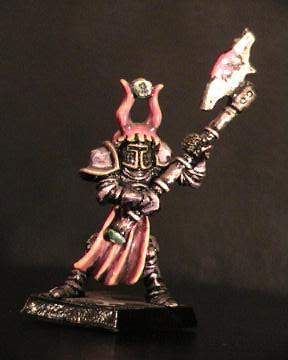
Sad AD&D Nerd Stands Revealed
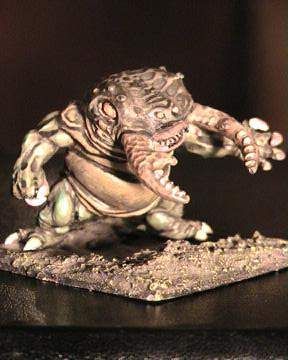
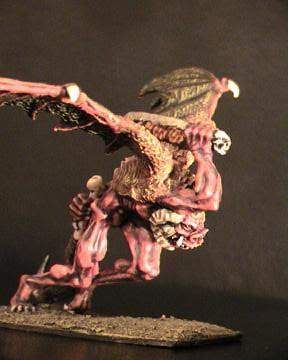
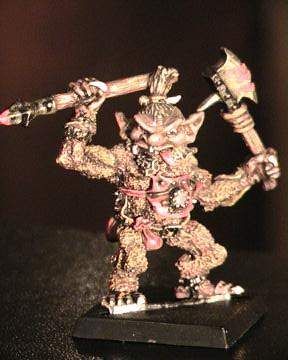
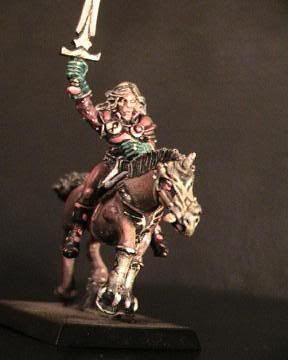
I came across some of my old minatures when I was cleaning out the Cupboards: I painted them when I was in my early teens.


Labels:
Artwork
Thursday, December 09, 2010
Mechanisms of Authority.
I just passed a happy half-hour on the motorway thinking about authority.
As far as I could decide, auothority at base starts with ownership. As defacto owners of our bodies, by means of direct control over it, we could be said to have authority over its behaviour, and the ends to which it is put. The caveat of ownership being a means of adequate defence. You do not truly own what you cannot defend and protect. A kid with a gold brick possesses it only at the retraint of those around them.
Anyway, we cede that authority over ourselves to others in a number of cases - which I've loosely grouped into 3 basic types: Impositonal assumption of authority, intrinsic and situational. The lines between them are a bit fuzzier in real life, but then, they always are.
Impositional: This is the most powerful, and also the most useless way to assume authority over others. Brute force. The classic "I have a gun/sword/kung-fu, do what I say, or I will feed you your own spleen." means of assuming control over others. Effective, because whilst you hold the gun, others have no choice but to obey, useless, because they will not respect your assumed authority, and attempt to wrest it from you.
Why..?
Because as a species we naturally form fixed heirarcies and, unless that heirarchy is based solely on brute force and no other criteria, are quick to notice cheaters. Grabbing an automatic weapon and taking over a post-office is not the same as working there for long enough to go up through the established (merit-based) heirarchy to the level of postmaster general, or whatever. The gun-gambit, to use a very English metaphor, is a form of queue-jumping, and as such... Frowned upon in polite society - perpetrators to be brought low for their temerity.
At a conceptual level however, this kind of authority ammounts to theft, those who impose it effectively 'steal' our bodies from us, stripping us of the defence that supports self-ownership.
A second version of brute force is disguised by monopoly. If I control a vital resource, you are obliged to do what I say in order to achieve it. The brute-force bit here is indirect, because my monopoly depends on my ability to protect it from those who would take it from me, and the ownership of that capacity (for violence) guarrentees my ownership of the resource, which I use to control you.
It doesn't really need to be said that authority at the governmental level is of this sort, the irony being that the thing governments monopolize is the capacity for organized violence itself.
Institutional/Situational: This the most common means of assuming authority over others, one operating within an already established heirarchy/social infrastructure. Example: Me. I'm a teacher. But the question is whether or not my students (or rather those who find themselves occupying the space commonly accepted as that of a student) obey me in the classroom because I am me in particular, or because I simply occupy the space in the classroom where a teacher (to whom students are expected to cede temporary authority over their behaviour) would be.
How much authority is ceded, and how unswervingly that authority is obeyed is governed by socially inculturated archetypes. Imagine a generalized 'teacher', you'll find you have a fairly distinct picture, both in physical appearance and demeanor, already in your head. Statistically, a student judges the 'teacheriness' of a new teacher within the first few initial seconds of meeting them, and sticks to that first impression quite rigidly throughout their time together, acting accordingly.
In my profession, the main requirement is being able to 'fit' myself into that archetype. Actually having a clue about what I'm teaching is a plus, but secondary, at least from an authority-POV.
It is this same authority mechanism that makes us unthinkingly obey Doctors when they say "take off your shirt please madam", priests when they tell us to do penance for our sins, and parking-attendants when they say "move your fucking car please sir."
This kind of authority is largely impersonal, lent almost entirely by the situation involved, and as such transient. The magic rubbing off as soon as that situation is no longer at hand. Put a teacher in an ambulance, and his authority is overruled. Take the priest from the church, and put him in burning building, and some hulking guy with a fire-axe will boss him about. Put a parking-attendant almost anywhere, and they'll be ignored. It is also dependent on accoutrements - the trappings of power - whether it be a cloak and sceptre, or a pipe and a pair of leather patches on the elbows of your tweed jacket. Remove those symbols of position, and authority wears off. Superman without his cape is just some fucking douche journo, ignored, at least until he falls back on impositional authority and punches some guy through a wall.
However, institutionalized authority does rub off on the person occupying that place, if they spend enough time there. Leading us to the last version of authority.
Intrinsic: This, being the opposite of impositional, is the hardest to achieve, but the most useful. This is the authority assumed by natural leaders. It is asserted by physical and vocal presence, and a personality of utmost confidence - one that is so used to being obeyed that it behaves as if that act of submission has already occurred. The person involved, if you like, carries and generates the situation in which it seems natural to those around them to cede authority without question. Appearance-wise they 'fit' enough of the key qualities general to many of the archetypes of institutionalised authority of the time, enough at least to automatically impress.
This form of authority is useful twice, once because it alows the assumption of authority in many/all situations and is thus 'portable', and twice because those ceding authority over themselves to the person in question do so willingly, unresentfully in the main, and for a much longer period.
As far as I could decide, auothority at base starts with ownership. As defacto owners of our bodies, by means of direct control over it, we could be said to have authority over its behaviour, and the ends to which it is put. The caveat of ownership being a means of adequate defence. You do not truly own what you cannot defend and protect. A kid with a gold brick possesses it only at the retraint of those around them.
Anyway, we cede that authority over ourselves to others in a number of cases - which I've loosely grouped into 3 basic types: Impositonal assumption of authority, intrinsic and situational. The lines between them are a bit fuzzier in real life, but then, they always are.
Why..?
Because as a species we naturally form fixed heirarcies and, unless that heirarchy is based solely on brute force and no other criteria, are quick to notice cheaters. Grabbing an automatic weapon and taking over a post-office is not the same as working there for long enough to go up through the established (merit-based) heirarchy to the level of postmaster general, or whatever. The gun-gambit, to use a very English metaphor, is a form of queue-jumping, and as such... Frowned upon in polite society - perpetrators to be brought low for their temerity.
At a conceptual level however, this kind of authority ammounts to theft, those who impose it effectively 'steal' our bodies from us, stripping us of the defence that supports self-ownership.
A second version of brute force is disguised by monopoly. If I control a vital resource, you are obliged to do what I say in order to achieve it. The brute-force bit here is indirect, because my monopoly depends on my ability to protect it from those who would take it from me, and the ownership of that capacity (for violence) guarrentees my ownership of the resource, which I use to control you.
It doesn't really need to be said that authority at the governmental level is of this sort, the irony being that the thing governments monopolize is the capacity for organized violence itself.
Institutional/Situational: This the most common means of assuming authority over others, one operating within an already established heirarchy/social infrastructure. Example: Me. I'm a teacher. But the question is whether or not my students (or rather those who find themselves occupying the space commonly accepted as that of a student) obey me in the classroom because I am me in particular, or because I simply occupy the space in the classroom where a teacher (to whom students are expected to cede temporary authority over their behaviour) would be.How much authority is ceded, and how unswervingly that authority is obeyed is governed by socially inculturated archetypes. Imagine a generalized 'teacher', you'll find you have a fairly distinct picture, both in physical appearance and demeanor, already in your head. Statistically, a student judges the 'teacheriness' of a new teacher within the first few initial seconds of meeting them, and sticks to that first impression quite rigidly throughout their time together, acting accordingly.
In my profession, the main requirement is being able to 'fit' myself into that archetype. Actually having a clue about what I'm teaching is a plus, but secondary, at least from an authority-POV.
It is this same authority mechanism that makes us unthinkingly obey Doctors when they say "take off your shirt please madam", priests when they tell us to do penance for our sins, and parking-attendants when they say "move your fucking car please sir."
This kind of authority is largely impersonal, lent almost entirely by the situation involved, and as such transient. The magic rubbing off as soon as that situation is no longer at hand. Put a teacher in an ambulance, and his authority is overruled. Take the priest from the church, and put him in burning building, and some hulking guy with a fire-axe will boss him about. Put a parking-attendant almost anywhere, and they'll be ignored. It is also dependent on accoutrements - the trappings of power - whether it be a cloak and sceptre, or a pipe and a pair of leather patches on the elbows of your tweed jacket. Remove those symbols of position, and authority wears off. Superman without his cape is just some fucking douche journo, ignored, at least until he falls back on impositional authority and punches some guy through a wall.
However, institutionalized authority does rub off on the person occupying that place, if they spend enough time there. Leading us to the last version of authority.
Intrinsic: This, being the opposite of impositional, is the hardest to achieve, but the most useful. This is the authority assumed by natural leaders. It is asserted by physical and vocal presence, and a personality of utmost confidence - one that is so used to being obeyed that it behaves as if that act of submission has already occurred. The person involved, if you like, carries and generates the situation in which it seems natural to those around them to cede authority without question. Appearance-wise they 'fit' enough of the key qualities general to many of the archetypes of institutionalised authority of the time, enough at least to automatically impress.
This form of authority is useful twice, once because it alows the assumption of authority in many/all situations and is thus 'portable', and twice because those ceding authority over themselves to the person in question do so willingly, unresentfully in the main, and for a much longer period.
Labels:
social,
social commentary
Wednesday, December 01, 2010
The Brain that Talked to Itself.
I was talking with a friend the other day about language and thinking, and how the brain does it. He said, quite emphatically:
And I was pretty much tsaying that it doesn't.
Not as he imagined anyway.
Linguistic representation is to the brain is as sky-writing in a plane is to us. Effortful, showy, slow, and kinda dumb. Imagine Shakespeare writing all his plays with the aid of a funky single-prop plane.
First, let's talk about speed. I'm just gonna write "I want to go to town and get a pizza" on a bit of paper. Okay, it took me 14 seconds. Now, I'm gonna type it. i want to go to town and get a pizza. I cheated a bit with the capitals. Still it took 10 seconds. I am only a three-and-a-half finger typist however, I imagine their are faster typers out there.
Now, I'm going to risk a few weird looks and say it out loud, at a normal conversational pace. Took about 2 seconds. And one weird look. Now I'm going to say it as fast as I can. awannagotatownangettapizza. About a second. Now I'm gonna think it.
That's where it gets tricky. If I simply mentally speak it, it takes the same time as the speakasfastasican version. Which is no surprise as the systems are the same, except during 'speech thinking' your brain simply supresses the movements of your tongue and mouth. However, if I don't really try to 'say' it seems just to hover there whole. Taking no time that I can measure on my watch anyway.
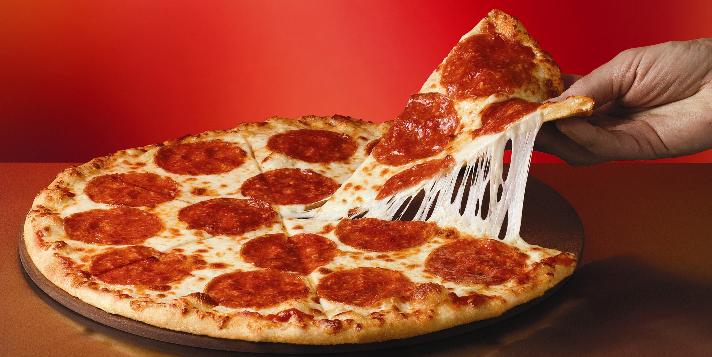
Quick. Imagine a pizza.
You did didn't you. Bing - there it was. Now, if I'd asked you to describe a pizza using words, you'd have been half an hour or so, depending on how diligently you undertook the task. But its visualization, seeing it in your mind full of steamy pepperoni goodness, took absolutely very very little time at all.
That's as fast as your brain can go. Except it isn't because in this case, in the case of speech acts and conscious thinking acts, your train of thought tends to stop at each station along the way. We stopped at 'pizza junction' and stayed a while, before moving on. But in 'unconscious' processing, that train doesn't stop ever, until it reaches 'action station'. What's more, it pretty much calves off other trains along the way, sending them off down other routes to the same destination. All the points are open, all the guards are frantically waving them through with green flags. All the cows are cleared off the lines. ZZZooooommmm.
To continue. You're prolly thinking right now "Yeah okay, so the brain talks really fast, but it's still talking - so what..?"
Aha.
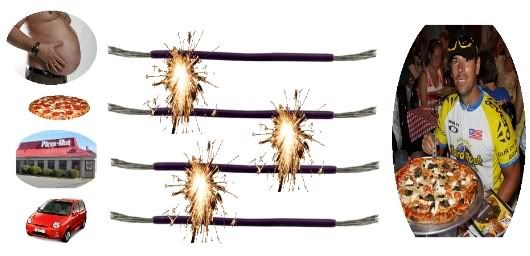
I want you to imagine some wires. Most of these wires are very very thin, like the ones you get in the guts of cheap chinese toys. Their insulative sheaths are even thinner. Imagine them all lying very close to eachother. Let's zoom into two. One is the hunger wire. The other is the pizza wire. The hunger wire, being a basic drive, is comparitively big, and carries quite a bit of current. The pizza wire is thin, and carries just a trickle.
Now. One day you are at home, and you're hungry. The hunger wire is firing. Someone's left a half a pizza uneaten in the oven. Pizza wire fires. You eat the pizza, pizza wire and hunger wire are firing separately, but at the same time.
Let's say you do that a lot.
Pizza wire and hunger wire spend quite a bit of time firing at the same time. The wires get hot, and where they lie very close together, their sheaths touching, one day, the sheaths melt due to the heat, and suddenly, in a flash, the two wires join at that point.
They technically become one wire. So, whenever you feel hungry, the hunger wire fires, and automatically its charge also flows through the pizza wire, now cojoined, instantly. But also the reverse happens, and when you see a pizza, the pizza wire also fires a charge through the cojoined hunger wire, and you get hungry. A bit.
But the story doesn't end here. Adjacent to the pizza wire are other wires. Citymap wires, transport wires, location wires. One day, when there is no pizza at home, you dig out the menu, find the location, and get out the car keys. You do that a lot too. More wires, firing together often, burn through their sheaths, and become cojoined.
Pic time.
You see, at this level of brain function, there is no language, only clusters of neurones firing at the same time. Hit the hunger button and the choice is already made, the action of hitting the hunger button contains all the rest in one, due to the connections involved.
What happens though, when we do engage our conscious minds to say things like ""I want to go to town and get a pizza" is different.
At the single wire level, the wire is just a conduit. All the biochemical causes of hunger siphon into this wire, and at the other end, the feeling of hunger comes out. Same with pizza, all the perceptual and conceptual properties of pizza siphon into this wire, and come out - bing - as the brain's composite map of pizza. Its spacial location, its connectivity contain the meaning built in. The wire is the thing.
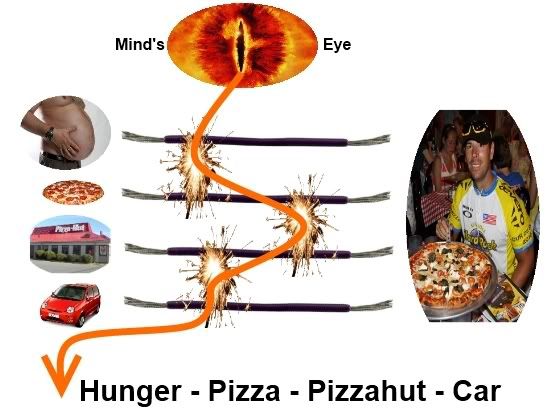
But when you get a cojoining of wires - of Hunger and pizza, that nodal point in the network gives you the brain's version of a phrase. "Hunger pizza". Another pic.
Now as the picture shows simplistically, the conscious mind is like an eye above the brain. When our consciosness formulates language, about what we are doing/going to do etc. It checks the net, portions of which are firing as one, and focusses on the nodes of cojoinment, puts them in a cocktail shaker, shakes, looks at its watch for tenses, and adds grammar.
Hungerpizzapizzahutcar becomes "I'm hungry so I'm gonna get a pizza from pizzahut in my car."
Now, there are two ways to go from here.
The first path "no conscious involvment in choice": Here, the neural net firing in a certain pattern due to the initial input of hunger, or pizza, or a pizzahut advert on the telly, makes the choice automatically - the firing and the 'choice' are combined. And the conscious mind, examining the net's state gets its answer like some ancient Delphic oracle asking "What am I doing" and receiving Apollo's reply. "Oh right" the conscious mind says "I'm doing this apparently." as his body is already moving.
ie. it arrives too slow at the choice party, and sits in the corner sober, while all the neurones get off with each other.
The second path: "Conscious involvement in choice": The conscious mind, examining the neural net, finds out what the neural net has already decided based on the input so far, and excersizing an executive function either goes with it, or vetos it and re-runs the series with added inputs.
But as to which of those paths is the 'true' one... I have no idea.
"brain chemistry must have something in it that represents a statement in a linguistic way"
And I was pretty much tsaying that it doesn't.
Not as he imagined anyway.
Linguistic representation is to the brain is as sky-writing in a plane is to us. Effortful, showy, slow, and kinda dumb. Imagine Shakespeare writing all his plays with the aid of a funky single-prop plane.
First, let's talk about speed. I'm just gonna write "I want to go to town and get a pizza" on a bit of paper. Okay, it took me 14 seconds. Now, I'm gonna type it. i want to go to town and get a pizza. I cheated a bit with the capitals. Still it took 10 seconds. I am only a three-and-a-half finger typist however, I imagine their are faster typers out there.
Now, I'm going to risk a few weird looks and say it out loud, at a normal conversational pace. Took about 2 seconds. And one weird look. Now I'm going to say it as fast as I can. awannagotatownangettapizza. About a second. Now I'm gonna think it.
That's where it gets tricky. If I simply mentally speak it, it takes the same time as the speakasfastasican version. Which is no surprise as the systems are the same, except during 'speech thinking' your brain simply supresses the movements of your tongue and mouth. However, if I don't really try to 'say' it seems just to hover there whole. Taking no time that I can measure on my watch anyway.
Quick. Imagine a pizza.
You did didn't you. Bing - there it was. Now, if I'd asked you to describe a pizza using words, you'd have been half an hour or so, depending on how diligently you undertook the task. But its visualization, seeing it in your mind full of steamy pepperoni goodness, took absolutely very very little time at all.
That's as fast as your brain can go. Except it isn't because in this case, in the case of speech acts and conscious thinking acts, your train of thought tends to stop at each station along the way. We stopped at 'pizza junction' and stayed a while, before moving on. But in 'unconscious' processing, that train doesn't stop ever, until it reaches 'action station'. What's more, it pretty much calves off other trains along the way, sending them off down other routes to the same destination. All the points are open, all the guards are frantically waving them through with green flags. All the cows are cleared off the lines. ZZZooooommmm.
To continue. You're prolly thinking right now "Yeah okay, so the brain talks really fast, but it's still talking - so what..?"
Aha.
I want you to imagine some wires. Most of these wires are very very thin, like the ones you get in the guts of cheap chinese toys. Their insulative sheaths are even thinner. Imagine them all lying very close to eachother. Let's zoom into two. One is the hunger wire. The other is the pizza wire. The hunger wire, being a basic drive, is comparitively big, and carries quite a bit of current. The pizza wire is thin, and carries just a trickle.
Now. One day you are at home, and you're hungry. The hunger wire is firing. Someone's left a half a pizza uneaten in the oven. Pizza wire fires. You eat the pizza, pizza wire and hunger wire are firing separately, but at the same time.
Let's say you do that a lot.
Pizza wire and hunger wire spend quite a bit of time firing at the same time. The wires get hot, and where they lie very close together, their sheaths touching, one day, the sheaths melt due to the heat, and suddenly, in a flash, the two wires join at that point.
They technically become one wire. So, whenever you feel hungry, the hunger wire fires, and automatically its charge also flows through the pizza wire, now cojoined, instantly. But also the reverse happens, and when you see a pizza, the pizza wire also fires a charge through the cojoined hunger wire, and you get hungry. A bit.
But the story doesn't end here. Adjacent to the pizza wire are other wires. Citymap wires, transport wires, location wires. One day, when there is no pizza at home, you dig out the menu, find the location, and get out the car keys. You do that a lot too. More wires, firing together often, burn through their sheaths, and become cojoined.
Pic time.
You see, at this level of brain function, there is no language, only clusters of neurones firing at the same time. Hit the hunger button and the choice is already made, the action of hitting the hunger button contains all the rest in one, due to the connections involved.
What happens though, when we do engage our conscious minds to say things like ""I want to go to town and get a pizza" is different.
At the single wire level, the wire is just a conduit. All the biochemical causes of hunger siphon into this wire, and at the other end, the feeling of hunger comes out. Same with pizza, all the perceptual and conceptual properties of pizza siphon into this wire, and come out - bing - as the brain's composite map of pizza. Its spacial location, its connectivity contain the meaning built in. The wire is the thing.
But when you get a cojoining of wires - of Hunger and pizza, that nodal point in the network gives you the brain's version of a phrase. "Hunger pizza". Another pic.
Now as the picture shows simplistically, the conscious mind is like an eye above the brain. When our consciosness formulates language, about what we are doing/going to do etc. It checks the net, portions of which are firing as one, and focusses on the nodes of cojoinment, puts them in a cocktail shaker, shakes, looks at its watch for tenses, and adds grammar.
Hungerpizzapizzahutcar becomes "I'm hungry so I'm gonna get a pizza from pizzahut in my car."
Now, there are two ways to go from here.
The first path "no conscious involvment in choice": Here, the neural net firing in a certain pattern due to the initial input of hunger, or pizza, or a pizzahut advert on the telly, makes the choice automatically - the firing and the 'choice' are combined. And the conscious mind, examining the net's state gets its answer like some ancient Delphic oracle asking "What am I doing" and receiving Apollo's reply. "Oh right" the conscious mind says "I'm doing this apparently." as his body is already moving.
ie. it arrives too slow at the choice party, and sits in the corner sober, while all the neurones get off with each other.
The second path: "Conscious involvement in choice": The conscious mind, examining the neural net, finds out what the neural net has already decided based on the input so far, and excersizing an executive function either goes with it, or vetos it and re-runs the series with added inputs.
But as to which of those paths is the 'true' one... I have no idea.
Labels:
neurophysiology