Sunday, November 21, 2010
Monday, September 27, 2010
The Inevitabilist goes to the Theatre
One sunny Tuesday afternoon the Inevitabilist was sitting at home when the telephone rang. It was Goldie. He liked her because she possessed the uncanny ability, when presented with three options, to always choose the one that was just right.
"Hey Mr. I, I'm bored stupid, y'wanna take me out to the theatre..?"
"Sure. One condition though."
"Okaay - what is it..?"
"Whichever one we go to, it's gotta have gravity..."
"You're never gonna let me live that one down are you. I said sorry about a million times already."
"Can't help it - we sat there for 14 billion years and nothing happened. My arse got so numb I forgot I had one."
"Gravitygravity I get it, no more minimalist art. Okay -
"And planets this time, gotta have planets."
- fuck, okay planets too - I'm checking the listings here. That leaves us with three."
"Fine, let's go check them out."
"What..? Now..? It's far too early, none of the plays are even scheduled to start till seven or so."
"Well, you know me, I like to know the initial conditions."
"Oof - can't you just get off the whole inevitabilist schtick for one fucking second..?"
"No."
"Jesus. You're about as spontaneous as a concrete beam you know that..?"
"It's my nature."
The two of them got out of the car and pushed open the gilt-framed doors of the first theatre. The receptionist agreed to let them tour the premises on the proviso they both signed the release forms, and called over the usher. The usher passed them each oxygen tanks and hard radiation suits. After instructing them in the basic safety protocols, he ushered them into the theatre.
Even with the masks on, it was hard to breathe. The air tasted of vinegar and the spotlights threw out such immense heat that the outer layers of their suits began to smolder. Beneath their boots the jagged terrain heaved as the magma underneath convusled to some unknown rhythm. They lasted about three minutes before they fled, noses streaming and sweat sluicing off their skins.
"Too hard" Said Goldie.
"Yeah, I'm guessing lichen at best, and even then only in the deeper crevices."
"Crick neck..?"
"Crick neck."
So they went to the next.
This time the usher passed them both aqualungs and flippers. Sunlight filtered down from the ornate ceiling, turning the water to gold. Green motes of dust-sized life hazed the tide. The water, warm nearer the top, cooled slowly, in steps almost, as they glided down to the sandy bottom of the theatre, weightless, turning fat lazy spirals in the deepening dark.
"So, whaddya think..?" Said the inevitabilist, dragging a towel through his hair.
"Too soft." Said Goldie.
"Dolphins can be fun you know - hoops and stuff."
"Hah, you're just testing me again you bastard. Can't have dolphins without an interim on land, even I know that. No land, easy life, no complex problems to solve - that place'll be just fish, fish and more fucking fish. Bor-ing..."
"You swear too much to ever be a real lady."
"And fuck you too." Goldie smiled, "C'mon - time's a wastin'."
The third theatre was vast, and they were told it had three salons, rather than just the one. The usher looked at them strangely when they asked if they had to wear any special equipment. Inside the theatre the air was cool, the spotlights were again huge, but dimmed - though they looked as if they could make things hot if need be. In the wings however there were titanic air-conditioning units, ready to pump out mini-ice-ages should events call for them. There was water, there were mountains. Trees to climb and grass to wade through. Animals in every shape and form rustled through the underbrush, whales and minnows flopped and tumbled in the waves.
"Just right." Said Goldie.
"Yeah - Diversity." Relipied the Inevitabilist. "Always a good sign. C'mon - Let's go for a drink in the bar and look at the programmes."
"k."
The bar was cool and pleasantly crowded. Goldie and the Inevitabilist took seats in a booth that had a good view of the room.
"Screwdriver please, amaretto if you goddit."
"I'll have a beer. No, just whatever comes without fruit stuck out of the top. Yeah, that'll be fine. Cold glass."
"That sea theatre reminded me of a funny story I heard yesterday. Y'wanna hear it..?" Said Goldie over the top of her cocktail glass.
"All ears."
"Did you know octopuses, -pi whatever, have elbows..?"
"Really..?"
"Yeah. Listen -
The Inevitabilist waggled his head. "Not really, I keep tellling you there are optimal solutions to problems inherrent in the physical world, and that life will naturally arrive at them, from whatever direction. Eyes have been invented twice, and wings three times - they're inevitable, if there's light, if there's air. Just a matter of time."
"Yeah-yeah, so you've said. I get it I get it. But I still don't think that idea translates to human society." She let out her breath in an orangey-vodka tinted cloud, still thinking about octopi with elbows and wrists, suckered little fingers.
"You read that book I gave you..? Machiavelli..?"
"Sure, not exactly Mills and Boon."
"You remember when he wrote it..?"
"Uh - fifteen hundred and something I think."
"Yeah - 1513AD. What would you say if I said someone else wrote damn near the same book half the world away in India about 1800 years before he did..?"
"I'd say you were fucking shitting me."
"It's called the Arthashastra written by some guy to advise the Maharajas of the Maurya Empire."
"Okay, so I'm suitably amazed at the depth of your useless knowledge, but so what..?"
"What I mean is the Prince is still read and put into practice today, except by business execs rather than kings. And stuff like 'The Art of War' by some Chinese guy back in 6th century BC - still on the syllabus of military service examinations in many East Asian countries."
"And this is relevant because..."
"Because it means that some social situations demand the same answers, whenever these situations arise. These solutions are timeless - doesn't matter if it's cavemen or techno-fetishist geek droid soldiers. The underlying rules of obtaining power, keeping power, protecting power within a group of sentient beings with conflicting interests never changes. A bit like your octopus and its elbows. The same solutions arising time and time again throughout evolution, except this time throughout social history as well. The time, the people, not as important as you'd think, you know..?"
“Yeah, well those are just books, I mean maybe Machiavelli just like got that Indian guy’s book out of the library and totally ripped it off y’know – ever think of that..?”
“Okay. Not utterly impossible I suppose. Massively unlikely but still. Okay. Jesus.”
“Haha – I killed your theory.”
“Jesus.”
“Stop saying Jesus, it’s disrespectful.”
“No, I mean Jesus.”
“I said stop –
“No I mean Jesus for another example. ‘Turn the other cheek’ and all that jazz. Do you think Jesus and Von Neuman ever knew each other..?”
“Now you’re being ridiculous.”
“You ever heard of game theory..? Well, think about the old testament – ‘eye for an eye’ - vengeful God and all that..? And then Jesus saying ‘forgive those who fuck you over’ – at least once depending on your number of cheeks..?”
“Yes, yes, yes and yes, but again – so what..?”
“Well, it turns out that game theory, when run as a basis for computer models proves that the second best strategy for producing stable populations of co-operative agents is eye-for-an-eye, where an agent repays another agent’s trespasses with a trespass of its own… And the best strategy is turn-the-other-cheek, where an agent forgives another’s first trespass on the off-chance it was a mistake, and the pair resume mutual co-operation without falling into vendetta. And don’t tell me Jesus had a laptop stashed under his robe.”
"Well, he was supposed to be the son of God, that'd probably boost his IQ a bit -
"Hah - The point I'm trying to make is that there are underlying rules to any system, physical, social, doesn't matter, and that these rules were as good two thousand years ago as they are now, as good as they will be two thousand years hence."
"'Hence'..? Why are you coming over all shakespearean on me..?"
"Yeah-yeah, but you know what I'm saying right..?"
"All I know is I need another drink. Are we gonna look at these programmes or what Mr. Scintillating..?"
"Kinda, I'll do you a deal."
"Arrgh."
"You verry funnee. Anyway - You just show me the pictures of the cast and the set, and I'll tell you what's gonna happen in the play, okay..?"
"I love it when you come over all prophetic..."
Salon 1:
"Hmm. Okay. A weary and defeated people in the midst of severe economic crisis, looking for any kind of solution, any way to restore some kind of national pride, looking for scapegoats toward whom to shift the blame. I'm thinkng - huge power vaccuum. Guy with moustache and an eye for symbolistic art. Dinky uniforms. Eagles. A hearkening back to earlier, more heroic ancestors. Probably some kind of exceptional gene-stock forefather myth thang going on. "Pure race brought low by injudicious interbreeding" blurb maybe -
- huge expansionist drive. State takes over the economy. Everybody gets crappy jobs. Hard times, low pay, sacrifice. Severe work ethic requires propping up by propaganda. Deification of traits necessary to support wobbley economy embodied as inherrent in the ethnic group in power, demonization in contrast of any ethnic group conflicting with the still flakey control of the dictatorship...
...This one's gonna end in tears. I'm seeing genocide at least, world-wide dominance of the ruthlessly expansionist regime at most, if they aren't stopped early enough. Am I right..?"
"Scarily."
"Next plz."
Salon 2:
"Okay, let's see... A restless people under the rule of an imperial power, one -
"Look, no offence, this is all very entertaining and everything, but any grade-school kid with an interest in history could do what your doing right now."
"Um."
"I mean, blah blah, unrest, blah blah, civil disobedience, blah blah happy ending. What's your point..? Bad shit happens and someone always steps out of the crowd and saves the day - Hitler picks up a fucked-over post-WWI Germany and turns it into a juggernaut, India gets sucked dry by the Brits and up pops Ghandi and saves the day - and so it goes. What's that got to do with you claiming to know the future..? All this shit happened in the past, of course it's fucking obvious now... That doesn't mean it was obvious then. Things get all fucked up, and someone special comes along and unfucks them."
"Yeah, okay, you got me. Okay, question for you now."
"Shoot. I'm feeling fucking smart right now."
"Why Hitler..? Why Ghandi..? - I mean they both saved their countries, however temporarily on Hitler's part - but why wasn't Hitler like Ghandi, and why wasn't Ghandi like Hitler..?"
"Er. I dunno. Hitler wasn't Indian for a start."
"Exactly."
"I always worry when you agree with me."
"What I mean is we live under the illusion that just *anybody* can stand up out of the crowd and suddenly the world spins around their little finger. But, it's not true. Do you know how many others there were, pre-Ghandi who tried and failed to do what he did..?"
"No."
"Of course you don't cos no-one ever talks about them. "Did you hear about that guy who totally didn't succeed in freeing India..?" Never comes up in conversation. No-one makes movies about the losers, not unless they lost in an utterly heroic fashion."
"You've seen 300 Spartans once too often."
"THIS IS SPAR-[spit]-TA!!!!"
"Euww - a bit of your phlem went in my drink..! Get me another one right now."
"In a minute. Look - the Indian independence rumblings started in 1857, nearly 60 years before Ghandi ever set foot in India. The independence movement had any number of leaders, the first being the Mughal emperor Bahadur Shah II - a fucking emperor for God's sake."
"You swear too much to ever be a real gentleman."
"Screw you too. Anyway, the emperor and all his cronies totally fucked the situation up, made it worse in fact - the Brits abolished the East India company and replaced it with direct rule. And after that there were at least five or six other leaders between them and the arrival of Ghandi."
"Still lacking a point to all this."
"All these guys - heroic, charismatic, full up to the gills with convictions etc. etc. and none of them could fix India."
"Well, they weren't Ghandi. Duh."
"No. That's not it - the trouble was that none of them could fit into the Ghandi-shaped hole in the universe."
"What, you're saying that the man doesn't matter..?"
"Yeah, that's kinda what I'm saying. From my perspective the situation in India 'waited' for 60 years, until the right-shaped man fell into the right place, and if Ghandi hadn't come along in 1915, it would have gone right on waiting, for as long as the situation persisted."
"Whooo - straight over my head. Maybe I won't have that other drink."
"Okay look. You remember those toys you had when you were a kid - the ones where you have to put the right shapes in the right holes..? Course you do. Imagine the world is a really big one of those - some of the holes are pretty simple, and they get filled real quick. Some of the holes are really complicated. Thing is though, the world's in no hurry, and there are tonnes and tonnes of shapes knocking about. Millions, billions of them. All the world does is sit there and shake the box patiently, and wait for each hole to be filled. And when the world is fucked up, all it does is shake harder."
"Fuck, I must be drunk. That kinda makes sense."
"Study the situation hard enough, and you'll find the man or woman to fill it. Or wait long enough, and the situation will manufacture that person for you."
"Now I've completely lost you. People make their own decisions, they have free-will and stuff... Don't they..?"
"You've heard of something called the Stanford Prison experiment..? and Stockholme syndrome..?"
"Yeah, I remember you talking about that stuff before. Cut to the chase."
"Okay, basically, they make me think we're led into becoming who we are not so much through any personal aesthetic, but by the situations we find ourselves in, and the social expectations of the circles we move in. You with me..?"
"Let's just say I am, but after all the evolutionary crap we've been through to develop these huge and, I dunno, 'unique', brains of ours why would we suddenly chuck it all in for group-think..? What's so fatal about striking out alone..?"
"It's all about Hydra and Hercules."
"Er... Okay, I'm getting the many heads vs. one vibe here - but didn't Hercules win..?"
"Sure, but why was the Hydra so feared that they had to send Hercules after it in the first place..?"
"Erm, because the Hydra had killed a fucking huge bunch of people beforehand..?"
"Bingo. The Hydra lost one battle out of a gazillion, and Hercules had help anyway. Some chariot guy with a torch - Iolaus. Plus, he was the son of Jupiter."
"Okay, I'm starting to get your drift now. Let me do the next bit. You're trying to say that from an evolutionary POV. It's always better to be part of the Hydra, than to go it alone. That way, the only thing that can beat you is a real out of context problem - hah - gotcha now - "son of Jupiter" - a fucking huge meteorite or something - a real planet killer."
"Go on."
"Okay. So if you say Hydra represents the majority, no, hang on, represents whatever part of society that is winning all the battles, it's better to join 'em, rather than fight them - that way your kids get to live, especially if you haven't had them yet. And for humans, it's not enough to just say 'Gee okay, I'm gonna join you guys', you've gotta work out how they got to win all those battles in the first place - because it's indicative of them being, I dunno, somehow 'fitter' within the socio-political/physical enviroment or something. But that's still not enough, you've gotta do more - you've gotta become them."
"Because..."
"Goddamn you - because the situation has already dictated what strategies will succeed the best, not them in particular. Fuck. I'm convinced - I'm a believer. I mean - basically you're saying that we're like psychic chameleons or something, except we end up believing we were always the same colour we find ourselves to be, even if we only turned that colour like, five minutes ago..?"
"Yes - right on the money. But you're forgetting something. Ghandi - and people like him - the real paradigm changers - don't they seem different..? Truely unique..?"
"Er. I've a feeling you want me to say "Oh yeah" and then you'll turn out to have an ace up your sleeve..."
"Hah. You know me too well. But yeah. Y'see, Ghandi didn't just drop out of the sky and land in India with a solution he made up on the spot. He'd already been molded by his experiences in South-Africa."
"What I mean is, he wasn't a man alone, he was just another head of a successful hydra that grew in another country. His only difference - He moved."
"Whoo."
The two sat back, and slugged back what was left of their drinks contemplatively.
"Anyway - What's the last play..?" The Inevitabilist asked.
"Ooh - this one you won't get so easy - it's set in the future, so your fucking history books won't be any help to ya."
"Whatever - just show me the pic and I'll tell you exactly what the aliens are going to look like...
Salon 3:
...Okay they'll -
Goldie held up her hand. "No, don't fucking tell me - they'll be so like us it'll be scary... Right..?"
"Someone give the girl a gold star."
"Suddenly I'm bored by the whole idea of the theatre."
"Me too, seen it all before. Hmm... We could go back to my place and I'll put on my bear suit..?"
"Thought you'd never ask."
"Hey Mr. I, I'm bored stupid, y'wanna take me out to the theatre..?"
"Sure. One condition though."
"Okaay - what is it..?"
"Whichever one we go to, it's gotta have gravity..."
"You're never gonna let me live that one down are you. I said sorry about a million times already."
"Can't help it - we sat there for 14 billion years and nothing happened. My arse got so numb I forgot I had one."
"Gravitygravity I get it, no more minimalist art. Okay -
"And planets this time, gotta have planets."
- fuck, okay planets too - I'm checking the listings here. That leaves us with three."
"Fine, let's go check them out."
"What..? Now..? It's far too early, none of the plays are even scheduled to start till seven or so."
"Well, you know me, I like to know the initial conditions."
"Oof - can't you just get off the whole inevitabilist schtick for one fucking second..?"
"No."
"Jesus. You're about as spontaneous as a concrete beam you know that..?"
"It's my nature."
The two of them got out of the car and pushed open the gilt-framed doors of the first theatre. The receptionist agreed to let them tour the premises on the proviso they both signed the release forms, and called over the usher. The usher passed them each oxygen tanks and hard radiation suits. After instructing them in the basic safety protocols, he ushered them into the theatre.
Even with the masks on, it was hard to breathe. The air tasted of vinegar and the spotlights threw out such immense heat that the outer layers of their suits began to smolder. Beneath their boots the jagged terrain heaved as the magma underneath convusled to some unknown rhythm. They lasted about three minutes before they fled, noses streaming and sweat sluicing off their skins.
"Too hard" Said Goldie.
"Yeah, I'm guessing lichen at best, and even then only in the deeper crevices."
"Crick neck..?"
"Crick neck."
So they went to the next.
This time the usher passed them both aqualungs and flippers. Sunlight filtered down from the ornate ceiling, turning the water to gold. Green motes of dust-sized life hazed the tide. The water, warm nearer the top, cooled slowly, in steps almost, as they glided down to the sandy bottom of the theatre, weightless, turning fat lazy spirals in the deepening dark.
"So, whaddya think..?" Said the inevitabilist, dragging a towel through his hair.
"Too soft." Said Goldie.
"Dolphins can be fun you know - hoops and stuff."
"Hah, you're just testing me again you bastard. Can't have dolphins without an interim on land, even I know that. No land, easy life, no complex problems to solve - that place'll be just fish, fish and more fucking fish. Bor-ing..."
"You swear too much to ever be a real lady."
"And fuck you too." Goldie smiled, "C'mon - time's a wastin'."
The third theatre was vast, and they were told it had three salons, rather than just the one. The usher looked at them strangely when they asked if they had to wear any special equipment. Inside the theatre the air was cool, the spotlights were again huge, but dimmed - though they looked as if they could make things hot if need be. In the wings however there were titanic air-conditioning units, ready to pump out mini-ice-ages should events call for them. There was water, there were mountains. Trees to climb and grass to wade through. Animals in every shape and form rustled through the underbrush, whales and minnows flopped and tumbled in the waves.
"Just right." Said Goldie.
"Yeah - Diversity." Relipied the Inevitabilist. "Always a good sign. C'mon - Let's go for a drink in the bar and look at the programmes."
"k."
The bar was cool and pleasantly crowded. Goldie and the Inevitabilist took seats in a booth that had a good view of the room.
"Screwdriver please, amaretto if you goddit."
"I'll have a beer. No, just whatever comes without fruit stuck out of the top. Yeah, that'll be fine. Cold glass."
"That sea theatre reminded me of a funny story I heard yesterday. Y'wanna hear it..?" Said Goldie over the top of her cocktail glass.
"All ears."
"Did you know octopuses, -pi whatever, have elbows..?"
"Really..?"
"Yeah. Listen -
"A three-jointed human arm has only seven degrees of freedom, which are defined as the types of movements each joint can perform. Your shoulder and wrist each have three degrees of freedoms—each can tilt up and down, turn left and right, and can roll in a circular motion. Your elbow, however, only has one degree of freedom, which is tilting up and down.- so you see, they have elbows. Isn't that just like totally fucking amazing..?" Goldie said, eyes widening into great glittery pools of khôl.
Scientists consider each of an octopus' eight arms to possess a virtually infinite number of degrees of freedom, allowing them to bend and twist freely. But when it's time to eat, octopuses use their flexible muscles to form temporary, quasi-articulated joints that work similar to how human joints function.
Researchers recorded muscle activity in octopus limbs, and found that an arm generates two waves of muscle contractions that propagate toward each other. When the waves collide, they form a part-time joint.
This process occurs three times, forming a shoulder where the arm meets the body, a wrist where the suckers have grasped their food, and an "elbow" somewhere in between. The elbow typically exhibits the most movement during food retrieval.
The researchers say this is a remarkably simple and apparently optimal mechanism for adjusting the length of arm segments according to where the food item is grasped along the arm.
The similarity of structural features and control strategies between jointed vertebrate arms and flexible octopus limbs suggests that these configurations evolved separately in octopuses and vertebrates, a result scientists call an example of convergent evolution."
The Inevitabilist waggled his head. "Not really, I keep tellling you there are optimal solutions to problems inherrent in the physical world, and that life will naturally arrive at them, from whatever direction. Eyes have been invented twice, and wings three times - they're inevitable, if there's light, if there's air. Just a matter of time."
"Yeah-yeah, so you've said. I get it I get it. But I still don't think that idea translates to human society." She let out her breath in an orangey-vodka tinted cloud, still thinking about octopi with elbows and wrists, suckered little fingers.
"You read that book I gave you..? Machiavelli..?"
"Sure, not exactly Mills and Boon."
"You remember when he wrote it..?"
"Uh - fifteen hundred and something I think."
"Yeah - 1513AD. What would you say if I said someone else wrote damn near the same book half the world away in India about 1800 years before he did..?"
"I'd say you were fucking shitting me."
"It's called the Arthashastra written by some guy to advise the Maharajas of the Maurya Empire."
"Okay, so I'm suitably amazed at the depth of your useless knowledge, but so what..?"
"What I mean is the Prince is still read and put into practice today, except by business execs rather than kings. And stuff like 'The Art of War' by some Chinese guy back in 6th century BC - still on the syllabus of military service examinations in many East Asian countries."
"And this is relevant because..."
"Because it means that some social situations demand the same answers, whenever these situations arise. These solutions are timeless - doesn't matter if it's cavemen or techno-fetishist geek droid soldiers. The underlying rules of obtaining power, keeping power, protecting power within a group of sentient beings with conflicting interests never changes. A bit like your octopus and its elbows. The same solutions arising time and time again throughout evolution, except this time throughout social history as well. The time, the people, not as important as you'd think, you know..?"
“Yeah, well those are just books, I mean maybe Machiavelli just like got that Indian guy’s book out of the library and totally ripped it off y’know – ever think of that..?”
“Okay. Not utterly impossible I suppose. Massively unlikely but still. Okay. Jesus.”
“Haha – I killed your theory.”
“Jesus.”
“Stop saying Jesus, it’s disrespectful.”
“No, I mean Jesus.”
“I said stop –
“No I mean Jesus for another example. ‘Turn the other cheek’ and all that jazz. Do you think Jesus and Von Neuman ever knew each other..?”
“Now you’re being ridiculous.”
“You ever heard of game theory..? Well, think about the old testament – ‘eye for an eye’ - vengeful God and all that..? And then Jesus saying ‘forgive those who fuck you over’ – at least once depending on your number of cheeks..?”
“Yes, yes, yes and yes, but again – so what..?”
“Well, it turns out that game theory, when run as a basis for computer models proves that the second best strategy for producing stable populations of co-operative agents is eye-for-an-eye, where an agent repays another agent’s trespasses with a trespass of its own… And the best strategy is turn-the-other-cheek, where an agent forgives another’s first trespass on the off-chance it was a mistake, and the pair resume mutual co-operation without falling into vendetta. And don’t tell me Jesus had a laptop stashed under his robe.”
"Well, he was supposed to be the son of God, that'd probably boost his IQ a bit -
"Hah - The point I'm trying to make is that there are underlying rules to any system, physical, social, doesn't matter, and that these rules were as good two thousand years ago as they are now, as good as they will be two thousand years hence."
"'Hence'..? Why are you coming over all shakespearean on me..?"
"Yeah-yeah, but you know what I'm saying right..?"
"All I know is I need another drink. Are we gonna look at these programmes or what Mr. Scintillating..?"
"Kinda, I'll do you a deal."
"Arrgh."
"You verry funnee. Anyway - You just show me the pictures of the cast and the set, and I'll tell you what's gonna happen in the play, okay..?"
"I love it when you come over all prophetic..."
Salon 1:
"Hmm. Okay. A weary and defeated people in the midst of severe economic crisis, looking for any kind of solution, any way to restore some kind of national pride, looking for scapegoats toward whom to shift the blame. I'm thinkng - huge power vaccuum. Guy with moustache and an eye for symbolistic art. Dinky uniforms. Eagles. A hearkening back to earlier, more heroic ancestors. Probably some kind of exceptional gene-stock forefather myth thang going on. "Pure race brought low by injudicious interbreeding" blurb maybe -
- huge expansionist drive. State takes over the economy. Everybody gets crappy jobs. Hard times, low pay, sacrifice. Severe work ethic requires propping up by propaganda. Deification of traits necessary to support wobbley economy embodied as inherrent in the ethnic group in power, demonization in contrast of any ethnic group conflicting with the still flakey control of the dictatorship...
...This one's gonna end in tears. I'm seeing genocide at least, world-wide dominance of the ruthlessly expansionist regime at most, if they aren't stopped early enough. Am I right..?"
"Scarily."
"Next plz."
Salon 2:
"Okay, let's see... A restless people under the rule of an imperial power, one -
"Look, no offence, this is all very entertaining and everything, but any grade-school kid with an interest in history could do what your doing right now."
"Um."
"I mean, blah blah, unrest, blah blah, civil disobedience, blah blah happy ending. What's your point..? Bad shit happens and someone always steps out of the crowd and saves the day - Hitler picks up a fucked-over post-WWI Germany and turns it into a juggernaut, India gets sucked dry by the Brits and up pops Ghandi and saves the day - and so it goes. What's that got to do with you claiming to know the future..? All this shit happened in the past, of course it's fucking obvious now... That doesn't mean it was obvious then. Things get all fucked up, and someone special comes along and unfucks them."
"Yeah, okay, you got me. Okay, question for you now."
"Shoot. I'm feeling fucking smart right now."
"Why Hitler..? Why Ghandi..? - I mean they both saved their countries, however temporarily on Hitler's part - but why wasn't Hitler like Ghandi, and why wasn't Ghandi like Hitler..?"
"Er. I dunno. Hitler wasn't Indian for a start."
"Exactly."
"I always worry when you agree with me."
"What I mean is we live under the illusion that just *anybody* can stand up out of the crowd and suddenly the world spins around their little finger. But, it's not true. Do you know how many others there were, pre-Ghandi who tried and failed to do what he did..?"
"No."
"Of course you don't cos no-one ever talks about them. "Did you hear about that guy who totally didn't succeed in freeing India..?" Never comes up in conversation. No-one makes movies about the losers, not unless they lost in an utterly heroic fashion."
"You've seen 300 Spartans once too often."
"THIS IS SPAR-[spit]-TA!!!!"
"Euww - a bit of your phlem went in my drink..! Get me another one right now."
"In a minute. Look - the Indian independence rumblings started in 1857, nearly 60 years before Ghandi ever set foot in India. The independence movement had any number of leaders, the first being the Mughal emperor Bahadur Shah II - a fucking emperor for God's sake."
"You swear too much to ever be a real gentleman."
"Screw you too. Anyway, the emperor and all his cronies totally fucked the situation up, made it worse in fact - the Brits abolished the East India company and replaced it with direct rule. And after that there were at least five or six other leaders between them and the arrival of Ghandi."
"Still lacking a point to all this."
"All these guys - heroic, charismatic, full up to the gills with convictions etc. etc. and none of them could fix India."
"Well, they weren't Ghandi. Duh."
"No. That's not it - the trouble was that none of them could fit into the Ghandi-shaped hole in the universe."
"What, you're saying that the man doesn't matter..?"
"Yeah, that's kinda what I'm saying. From my perspective the situation in India 'waited' for 60 years, until the right-shaped man fell into the right place, and if Ghandi hadn't come along in 1915, it would have gone right on waiting, for as long as the situation persisted."
"Whooo - straight over my head. Maybe I won't have that other drink."
"Okay look. You remember those toys you had when you were a kid - the ones where you have to put the right shapes in the right holes..? Course you do. Imagine the world is a really big one of those - some of the holes are pretty simple, and they get filled real quick. Some of the holes are really complicated. Thing is though, the world's in no hurry, and there are tonnes and tonnes of shapes knocking about. Millions, billions of them. All the world does is sit there and shake the box patiently, and wait for each hole to be filled. And when the world is fucked up, all it does is shake harder."
"Fuck, I must be drunk. That kinda makes sense."
"Study the situation hard enough, and you'll find the man or woman to fill it. Or wait long enough, and the situation will manufacture that person for you."
"Now I've completely lost you. People make their own decisions, they have free-will and stuff... Don't they..?"
"You've heard of something called the Stanford Prison experiment..? and Stockholme syndrome..?"
"Yeah, I remember you talking about that stuff before. Cut to the chase."
"Okay, basically, they make me think we're led into becoming who we are not so much through any personal aesthetic, but by the situations we find ourselves in, and the social expectations of the circles we move in. You with me..?"
"Let's just say I am, but after all the evolutionary crap we've been through to develop these huge and, I dunno, 'unique', brains of ours why would we suddenly chuck it all in for group-think..? What's so fatal about striking out alone..?"
"It's all about Hydra and Hercules."
"Er... Okay, I'm getting the many heads vs. one vibe here - but didn't Hercules win..?"
"Sure, but why was the Hydra so feared that they had to send Hercules after it in the first place..?"
"Erm, because the Hydra had killed a fucking huge bunch of people beforehand..?"
"Bingo. The Hydra lost one battle out of a gazillion, and Hercules had help anyway. Some chariot guy with a torch - Iolaus. Plus, he was the son of Jupiter."
"Okay, I'm starting to get your drift now. Let me do the next bit. You're trying to say that from an evolutionary POV. It's always better to be part of the Hydra, than to go it alone. That way, the only thing that can beat you is a real out of context problem - hah - gotcha now - "son of Jupiter" - a fucking huge meteorite or something - a real planet killer."
"Go on."
"Okay. So if you say Hydra represents the majority, no, hang on, represents whatever part of society that is winning all the battles, it's better to join 'em, rather than fight them - that way your kids get to live, especially if you haven't had them yet. And for humans, it's not enough to just say 'Gee okay, I'm gonna join you guys', you've gotta work out how they got to win all those battles in the first place - because it's indicative of them being, I dunno, somehow 'fitter' within the socio-political/physical enviroment or something. But that's still not enough, you've gotta do more - you've gotta become them."
"Because..."
"Goddamn you - because the situation has already dictated what strategies will succeed the best, not them in particular. Fuck. I'm convinced - I'm a believer. I mean - basically you're saying that we're like psychic chameleons or something, except we end up believing we were always the same colour we find ourselves to be, even if we only turned that colour like, five minutes ago..?"
"Yes - right on the money. But you're forgetting something. Ghandi - and people like him - the real paradigm changers - don't they seem different..? Truely unique..?"
"Er. I've a feeling you want me to say "Oh yeah" and then you'll turn out to have an ace up your sleeve..."
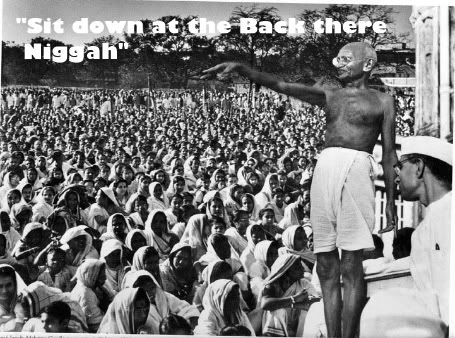
"Hah. You know me too well. But yeah. Y'see, Ghandi didn't just drop out of the sky and land in India with a solution he made up on the spot. He'd already been molded by his experiences in South-Africa."
"Mohandas Karamchand Gandhi (also known as Mahatma Gandhi), had been a prominent leader of the anti-Apartheid movement in South Africa, and had been a vocal opponent of basic discrimination and abusive labour treatment as well as suppressive police control such as the Rowlatt Acts. During these protests, Gandhi had perfected the concept of satyagraha, which had been inspired by the philosophy of Baba Ram Singh (famous for leading the Kuka Movement in the Punjab in 1872). The end of the protests in South Africa saw oppressive legislation repealed and the release of political prisoners by General Jan Smuts, head of the South African Government of the time."
"What I mean is, he wasn't a man alone, he was just another head of a successful hydra that grew in another country. His only difference - He moved."
"Whoo."
The two sat back, and slugged back what was left of their drinks contemplatively.
"Anyway - What's the last play..?" The Inevitabilist asked.
"Ooh - this one you won't get so easy - it's set in the future, so your fucking history books won't be any help to ya."
"Whatever - just show me the pic and I'll tell you exactly what the aliens are going to look like...
...Okay they'll -
Goldie held up her hand. "No, don't fucking tell me - they'll be so like us it'll be scary... Right..?"
"Someone give the girl a gold star."
"Suddenly I'm bored by the whole idea of the theatre."
"Me too, seen it all before. Hmm... We could go back to my place and I'll put on my bear suit..?"
"Thought you'd never ask."
Labels:
fiction,
inevitabilism,
philosophy,
social
Monday, September 20, 2010
Free-Will. Two Men & A Bear.
Funny how inspiration strikes sometimes. I was sitting on the balcony thinking about the debate with a friend, and about free-will. And that old joke about the two guys running from a bear popped into my head. You know the one - one guys says "Shit, we gotta outrun that bear." and the other guy says "Nah, I just gotta outrun you..."
And for some reason, something clicked.
We experience having free-will, and yet it seems to contradict everything else we observe. Something aloof from the usual clunk-clunk cause-effect universe.
If I were better at computers, I'd have produced a wonderful simulation to illustrate this next bit, but unfortunately, I'm not, so we'll have to do with imagination. Imagine a board, a bit like a chessboard, but bigger perhaps.
In the middle is a cafe. The cafe makes and serves only two kinds of food, blue food, and pink food. Dotted around the edges of the board are the homes of blue and pink people. They stay in their homes until they get hungry. Each get hungry at specific times, on utterly clockwork cycles, three times a day. When they get hungry, they move at a rate of one square a second, along the shortest path between their home, and the cafe. The blue people eat blue food, the pink people eat pink food. That's all they ever eat. After they've eaten, they go home, retracing their paths, to await the occasion of their next hungry cycle.
The chef in the cafe, knowing what they will eat, when they will eat it, and the exact times that each will appear in the cafe, buys stocks and prepares it accordingly, there is no lack, no waste, the food is always hot and ready as soon as the patrons sit at the tables.
It is a very simple simulation. No variables, no random factors. It runs faultlessly, automatically, day in, day out. The chef knows exactly what will happen at any given time, however far in the future that time may be. The system is utterly predictable, each node in constant lockstep with all the rest. Determined. There is no free will - no choice for the people to restrain or pre-empt their hunger, no choice of what route they will take, no choice of what they will eat. They make no choices, they also know exactly what they will be doing at any given time.
Obviously - this 'bears' no resemblance to reality. [Bears geddit..? Arf.]
Let's shake it up a little. Now the Pink people eat blue food, but only on Tuesdays, and the blue people, if it's a Thursday, eat pink. But it's too simple, the chef still is able to predict and plan to cater perfectly for his clientelle. Still a determined system.
Again, we'll add complexity. They go for haircuts on specific times every month, again, predictably and in an utterly clockwork fashion. The length of their hair affects what they can eat - short and they switch preferences until it grows past a specific length. Again, now if there are more right turns than left as they move across the board from their homes to the cafe they switch preference from the one dictated by day, or hair length. And again, if they are preceded by two people of the same colour, they switch from their previous preference.
Okay, now the situation is a lot more complex, I couldn't work it out straight off the cuff, but still the system is determined - the computer can run it perfectly. The chef buys his produce, cooks it serves it, no mess no fuss no waste.
The point I'm trying to make is that as long as the behaviour and preferences of the people living on the board are known explicitly, are predictable by the chef, the system is inarguably determined, and there is no question of choice involved on the parts of the pink and blue people.
Here's where the two guys and the bear come in. Except this time one of the guys is the conscious experience of free-will, and the other is autonomic prediciton, determinism. The bear, well hell, the bear's kind of extraneous, so he can still be a bear.
And to complicate matters, both these guys are running inside of one head. Your head. You have two guys and a bear in your head. Okay..? Also might help to view your brain as a great big prediction engine.
So, now imagine the head of a pink person. Which guy is running ahead of the other..?
Well, prediction of course. Prediction looks at his watch, remembers the time he was last hungry, works out when he will be next hungry, remembers the path he takes to the cafe, the turns it takes, the time it takes, knows what day it is, checks the length of his hair, knows his colour... And knows absolutely what he will being doing at any point in his future. Each moment, each action, flows seemlessly into the next like clockwork.
The experience of choice, the experience of free-will, is eaten by the bear.
But the brain, this marvellous prediction engine we all carry within the confines of our skulls, is only so big. Prediciton can only run so fast. If the number of states, the number of variables it has to deal with during predicitive acts goes over a certain [and pretty small really] limit, poor old prediction starts to stumble, starts to run out of breath.
And I think, that is when the experience of free-will, of choice, of being able to have chosen a different food to the one we find ourselves eating, begins to overtake. The chef drops his wok, fucks up his shopping list and starts swearing at the staff. Now it's prediction's turn to feel bear-nibble.
Did you know you are effectively blind for around forty minutes of each day..? It's called Saccadic masking. Basically, to prevent your world from looking like the jerky camcorder movie all day, your brain shuts down your optic nerve while your eye is in motion.
I have a feeling that our experience of deliberation, leading to the experience of having made a chioce, of free-will, is similar. A masking process, to cover the periods in time when our (unconscious) predictive engines get their cogs in a twist and can't get up sufficient momentum to whip us across from one action to the next.
When we walk, or climb stairs, we have no consciousness of having chosen where to put our feet. It takes a minefield, or a tango class to wake us up to what we're doing. It takes complexity, processing lag, to wake us up.
We observe, albeit with a few quantum quirks, an utterly deterministic universe. We ourselves are made of matter, our thoughts are generated and supported by physical sysytems. Our systems of meaning, of relating or associating thoughts and thought images are also deeply emeshed in the physical world, and are laid down according to experience in the physical world, in relation to physically limited parameters of chemical and electromagnetic brain function. There is no magic lurking in our synapses. No get out of jail-free cards.
I think what we experience as free-will, of choice, is simply a kind of papering over of the cracks, akin to a sort of maintained cycle of surprise - the brain locked in a state of not knowing wtf. is going to happen next.
Part of the experience of having free-will - of choosing - is the existence of multiple alternate futures we could have chosen from. In one future, I chose the fish, in another I chose the steak, in yet another I said "fuck this" and walked out. All seem to have hovered before our eyes, equally choosable at that moment of choice. Why would these ghosts of future possibles haunt me so, if there is no such thing as freedom of choice..?
Next slide please:
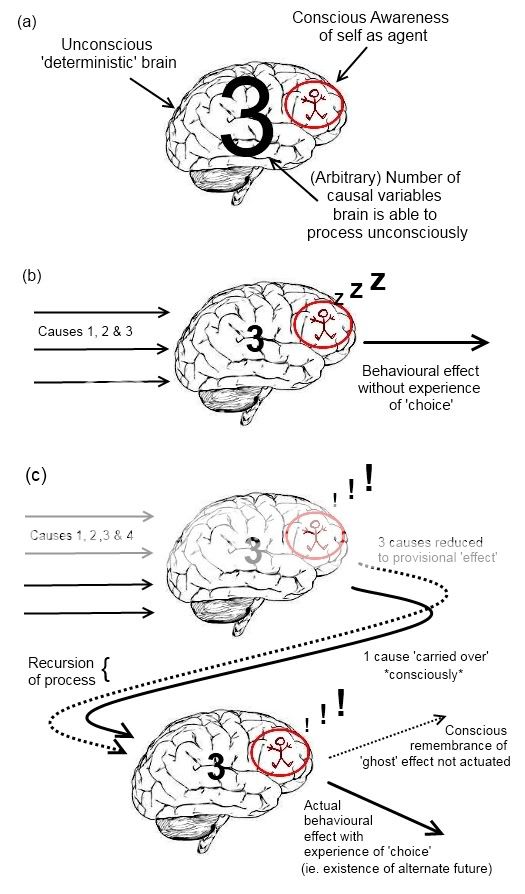
Obviously this model is woefully simple and doesn't indicate that all causatives are not external - there are a great number of internally-generated causatives or 'wants' - hunger for one, as exemplified in the original post. But it does emphasize the recursive/reductive processing the brain is forced into doing by the limits of its processing power.
The aforementioned wants and other drives that we experience are the condensed reductions of a myriad of other lesser causatives generated by the body - when we experience hunger we are not aware of the individual detail - PH of stomach, blood-sugar concentrations, the hormonal tides of circadian rhythms etc. etc. etc. - we simply feel 'hungry'. The brain has helpfully simplified the inputs from the body systems into a single imperative.
Getting back to the diagram, you must extrapolate the numbers of recursions our brain-states undertake when faced with difficult high-variable situations - generating multiples of alternate futures, which in turn are then re-considered - becoming virtual causatives in turn - and plowed back into the heuristics our brains use for reducing effect-clusters into behavioural imperatives - forcing action.
But I'm getting technical, which is always a bad sign. In short, we experience as part of the process of determined causal reduction - deliberation/choice - sometimes a myriad of alternate futures. But that does not mean we are as free as we think to act upon them.
I think it's about time to dredge out the classic Socratic "He who knows what is right will do right" there are of course many interpretations of this quote but to me, the implication of not being able to undertake an action deemed as 'wrong' has always been apparant. Put into cognitive terms: The brain seeks the 'right action' in response to a set of external and internal causative variables.
And once it alights upon what it defines as 'right action' undertakes that right action - this is the important bit - and no other.
The alternates we are aware of as we seem to choose are merely ghosts, never to have been realized - not ends in themselves, but simply parts of the process.
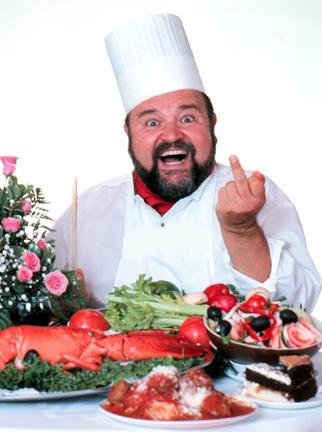
Another pillar supporting the notion of free-will and meaningful choice is external to the individual rather than hidden coiled and invisible within the crenulations of the brain. We in the world have surrounded ourselves by choice. The open buffét of real life...

...is a long way from the deterministic Café's blue food/pink food combo. Why so much choice if there is no free will..? I mean, it's one thing to fool ourselves, but a wholly other thing to fool the world.
It comes down to prediction once again. Remember the chef in the BluePink café..? How easy he had it, with his utterly predictable clientelle..? No mess, no fuss..? What would have happened if he'd launched a menu of orange food..? Well, it would have just rotted on the plates, untouched, un-ordered.
Trouble is, when it gets to the point where not only can you not predict the actions of others, but cannot even predict what you yourself will do from moment to moment with anything like total accuracy... Then making orange food doesn't seem so foolish.
Whether choice and the ability to choose is real or not, it doesn't matter. Illusion and reality aside - choice begets choice. The chef, faced with an unpredictable range of punters, is drawn to follow the path of making best guesses. Creating a broader range of food, following a bell-curve diversity of stuff he's come to observe everyone likes, quite a few people like, what's in vogue right now, what's in season right now, what's cheap and what's expensive right now. He also, like a speculative investor, will try to create a new menu option from time to time - a long-shot. I dunno - fried ice-cream or something.
Some of these long-shots will pay off, becoming subsumed within the great collective cuisine of the masses, others will be spat out, and get struck off the menu. But always the number of choices made available will grow. It will be the same in any industry - fashion, automotive etc. etc. Ford's classic "you can have any colour as long as it's black" never lasts. In attempting to cater for a range of tastes beyond his capability to predict accurately, the great chef will always err on the side of too much, rather than not enough, or be out-competed by the fancy restaurant next door.This last point is of dubious importance. It has to do with the idea of "shaping".
In the orignal model - the board-game world of predictable blue and pink people - the chef, because of his perfect knowledge of his patrons, was able to 'shape' himself to them. By this I mean he could perform his job so well as to become invisible to the person visiting his cafe. They would come in and the right food, at the right temperature, would have been placed on the table only seconds before their hand had alighted upon the handle of the cafe door. The need for interaction between the workings of the cafe, and the punter, drop to zero if prediction is total and accurate.
Now imagine a world that could predict you absolutely, and naturally shape its machinations around you, one that you could subconsciously predict perfectly yourself. Need you be conscious at all..? Would anything actually require your attention..? Or active involvement..? All would in effect, be one indivisible system, and would have always been one.
In short, I have a feeling that consciousness, our sense of individuality, and imperfect prediciton are very closely involved.
Labels:
neurophysiology,
philosophy
Wednesday, July 28, 2010
Conceptual Symbionts, Memes and Football
As you might have guessed by now - I hate the word 'memes' - it kicks up all sorts of images and associations with organicity that it shouldn't, so I came up with something better/less confusing/other. Ta-Da:
Conceptual symbionts.
My new and exciting bit of jargon. These little beasties are classified (a) by having no direct physical components, (b) by being a collection of ideas, or closer to the mark by being a sequence of ideas which both lead to and re-inforce eachother, and finally (c) once adopted, become indespensible on a global scale, at least for a period of time.
It must also be noticed that the initial idea in the sequence is one that is already implicit within whatever system it arises from.
I've searched around for a good illustration and come up with football. Not, alas, the American kind, because I don't know enough about it and lack the will to bother aquiring such knowledge, but the British kind. "Soccer". Blasphemy.
Back in the old days football was played very differently. Okay, so there was still the goalie, and 10 other guys dressed in shorts, and a ball, but the way the game was played. Basically, one guy would get the ball and, avoiding countless tackles by the opposing team, dribble it all the way to within shooting range. Then shoot. GOAL !!! Yay, everyone shout hip-hip-hooray.
Passing was very infrequent, done only under extreme duress, and usually backwards to another player who would attempt once again to get into the penalty box all on his lonesome. Basically, though all the players of any given team were nominally on the same side, they didn't really play together. "Team" was spelt with eleven "I"s.
I don't know who 'invented' the "passing game", I'm pretty dumb concerning football history - I blame growing up in a town where the home team was so pathetic no-one except the real anoraks ever supported them - but I think it was the continental teams when leagues started opening up internationally.
Basically three-men cells would run up the pitch and through strategic passing, circumvent any tackles coming their way, get within range and either blast one in directly, or again, lure the goalie into coming out early and pass around him.
They began to win every damn game, flattening the British teams completely. Outrage, this was our damn game..! How dare they, those foreign upstarts, who did they think they were..!

Of course, next season, many of the English teams were playing a passing game, at least the successful teams anyway. The one's that didn't, got relegated, and sank out of sight. After a while, the only teams left, were the ones which passed.
And this encapsulates the idea of a conceptual symbiont:
The first idea: "Pass the ball before you absolutely have to."
leads to: "Have someone ready to recieve it running nearby. Don't run up alone."
leads to: "Have that player run in a strict formation, so you will always already know roughly where to pass the ball, whenever pasing becomes necessary."
leads to, "Have two players in formation, in case one avenue of passing becomes obstructed."
Each idea leads from, supporting and extending, the former.
Then of course, the ideas begin to gloabally expand their effects, because they allow for specialisation. Whereas before each player had to be: A good runner, a good dribbler, a good tackler, a good striker - now with a three man group you could have one great striker, and two (or more) great dribblers to support him - laying the ball off to him after they had brought it to within range.
Midfielders to pick up loose balls, and double as striker-support, defenders to put down attacks - multiple, clearly defined roles, allowing for mutually supportive specialists.
All stemming from a simple initial idea of "pass the damn ball genius."
This is what I mean when I say "Conceptual Symbiont."
Anyway, since we've already got the football, we may as well run with it. Just imagine the football has a religious symbol on it.
Team size. In football, a team's limited to 11, plus a few subs. In life however, you can field as many players as you can get onto the pitch. There's more to it than that though - it's no good having more players if no-one knows which side they're playing for, or in which direction they should be kicking the ball.
The monkeysphere. I know I go on about this a lot, but it is absolutely foundational to any social theory. A.B.S.O. F.U.C.K.I.N.G. L.U.T.E.L.Y.
We're so blasé about meeting strangers these days. We see a dozen a day, and talk to/interact with a couple of them in the course of work/socializing whatever. We think nothing of it.
The only real predator of man left on the planet is man. So why aren't we scared of these everyday strangers..? I mean, imagine there was no law, no over-reaching systems of mutual co-operation - everything you owned, you made; everything you ate, you grew or raised; your water, you lugged up from the well yourself, from the river. The house you live in, the clothes you wear - all of them came from your hands. You do not need anything from another. And they, if they exist (you haven't seen them) shouldn't really need you for anything either. So why would they approach you..? Simple curiousity..? Imagine there's a mountain range between you and some guy you've only ever heard rumours about anyway, would simple curiousity be enough to get you to cross them..?
The only reasons for utterly self-sufficient groups, living in adequately-resourced areas isolate from each other, with no previous history of interaction, to visit one another, are bad ones.
Let me illustrate the situation:
Welcome to blob-land. I want you to imagine a bunch of blobs. They have two states: Sedentary and passive, mobile and aggresive. During their lifetimes, these blobs grow slowly, absorbing nutrients from the area where they lay until one of two things happens:
*Their size goes over a certain value, let's say around 250-300 units.
*They exhaust the nutrients of their locale.
In the first instance, the bloated mother blob splits, and calves off a new blob which promptly switches into mobile-aggressive mode and disappears over the horizon. This new blob doesn't stop until it finds somewhere with enough nutrients to support its growth, where it settles into sedentary mode. If there are no such places left unnoccupied it will attack and either displace another blob, or assimilate it utterly, unless driven off.
In the second case, the whole blob, whatever it's current size, switches into mobile aggressive mode and goes off on the hunt for somewhere new to live.
I think this, barring a little inter-group female raiding/exchange, adequately describes the general state of primitive mankind.
[Remember Game-theory 101..? Remember the initial winning strategy at low pop. density..? "Always default". ie, always attack, and always attack first. And remember, "Always default" is also responsible for keeping the pop. density low, it's a self-fulfilling prophecy.]
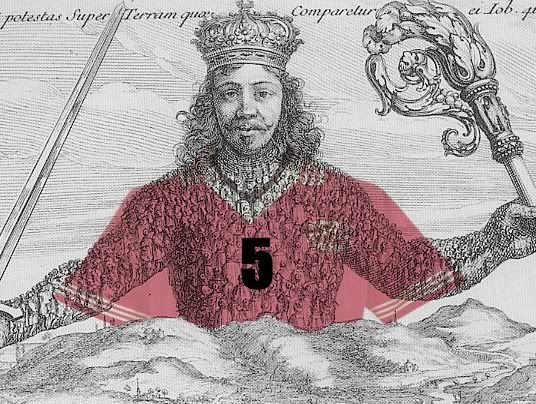
Now, we forgot football. Incorporating the above, I want you to imagine that the players in each team are not individuals, but blobs - groups of people about 150-200 - in size. For example - this is a mid-fielder - Hobbes.
He's quite a big lad, isn't he..?
But how is this Hobbesian game played..? Despite the general 'team'ness, there is no team. A player gets the ball, and is tackled. But the player, and the tackler, are largely on their own. It's one-on-one. In fact, the whole global game, despite there being 22 players on the pitch, is only ever one-on-one. In any tackle event, the other 20 players might as well not exist. No-one on either side will help their player/tackler because the target is 'the ball' and personal glory, not so much the overall outcome of the game - and under these conditions - a far better strategy is to wait until either the ball spins free, or to tackle whoever gets the ball, while they are tired from the recent conflict.
Now let's chuck one of the Hobbesian teams off the pitch, and install a passing-game playing continental. The players of this team have decided to sacrifice the personal glory of scoring an individual goal, to the more global joint-glory of 'winning the game'.
Which team wins..? Not a hard calculation. The continentals are playing eleven men against a team of one.
In summary - any conceptual symbiont that increases group cohesion or facillitates trust between unrelated groups - enabling the 'passing game' to be played - will tend to spread via proxy of those who believe. And as a species, we may have undergone coevolution with this emergent function - evolving more developed neurophysiologic 'organs' of belief, and boosting the ability of these beliefs, once formed, toward expression in the kind of consistant behaviour so crucial to mutual trust.
Conceptual symbionts.
My new and exciting bit of jargon. These little beasties are classified (a) by having no direct physical components, (b) by being a collection of ideas, or closer to the mark by being a sequence of ideas which both lead to and re-inforce eachother, and finally (c) once adopted, become indespensible on a global scale, at least for a period of time.
It must also be noticed that the initial idea in the sequence is one that is already implicit within whatever system it arises from.
I've searched around for a good illustration and come up with football. Not, alas, the American kind, because I don't know enough about it and lack the will to bother aquiring such knowledge, but the British kind. "Soccer". Blasphemy.
Back in the old days football was played very differently. Okay, so there was still the goalie, and 10 other guys dressed in shorts, and a ball, but the way the game was played. Basically, one guy would get the ball and, avoiding countless tackles by the opposing team, dribble it all the way to within shooting range. Then shoot. GOAL !!! Yay, everyone shout hip-hip-hooray.
Passing was very infrequent, done only under extreme duress, and usually backwards to another player who would attempt once again to get into the penalty box all on his lonesome. Basically, though all the players of any given team were nominally on the same side, they didn't really play together. "Team" was spelt with eleven "I"s.
I don't know who 'invented' the "passing game", I'm pretty dumb concerning football history - I blame growing up in a town where the home team was so pathetic no-one except the real anoraks ever supported them - but I think it was the continental teams when leagues started opening up internationally.
Basically three-men cells would run up the pitch and through strategic passing, circumvent any tackles coming their way, get within range and either blast one in directly, or again, lure the goalie into coming out early and pass around him.
They began to win every damn game, flattening the British teams completely. Outrage, this was our damn game..! How dare they, those foreign upstarts, who did they think they were..!
Of course, next season, many of the English teams were playing a passing game, at least the successful teams anyway. The one's that didn't, got relegated, and sank out of sight. After a while, the only teams left, were the ones which passed.
And this encapsulates the idea of a conceptual symbiont:
The first idea: "Pass the ball before you absolutely have to."
leads to: "Have someone ready to recieve it running nearby. Don't run up alone."
leads to: "Have that player run in a strict formation, so you will always already know roughly where to pass the ball, whenever pasing becomes necessary."
leads to, "Have two players in formation, in case one avenue of passing becomes obstructed."
Each idea leads from, supporting and extending, the former.
Then of course, the ideas begin to gloabally expand their effects, because they allow for specialisation. Whereas before each player had to be: A good runner, a good dribbler, a good tackler, a good striker - now with a three man group you could have one great striker, and two (or more) great dribblers to support him - laying the ball off to him after they had brought it to within range.
Midfielders to pick up loose balls, and double as striker-support, defenders to put down attacks - multiple, clearly defined roles, allowing for mutually supportive specialists.
All stemming from a simple initial idea of "pass the damn ball genius."
This is what I mean when I say "Conceptual Symbiont."
Anyway, since we've already got the football, we may as well run with it. Just imagine the football has a religious symbol on it.
Team size. In football, a team's limited to 11, plus a few subs. In life however, you can field as many players as you can get onto the pitch. There's more to it than that though - it's no good having more players if no-one knows which side they're playing for, or in which direction they should be kicking the ball.
The monkeysphere. I know I go on about this a lot, but it is absolutely foundational to any social theory. A.B.S.O. F.U.C.K.I.N.G. L.U.T.E.L.Y.
We're so blasé about meeting strangers these days. We see a dozen a day, and talk to/interact with a couple of them in the course of work/socializing whatever. We think nothing of it.
The only real predator of man left on the planet is man. So why aren't we scared of these everyday strangers..? I mean, imagine there was no law, no over-reaching systems of mutual co-operation - everything you owned, you made; everything you ate, you grew or raised; your water, you lugged up from the well yourself, from the river. The house you live in, the clothes you wear - all of them came from your hands. You do not need anything from another. And they, if they exist (you haven't seen them) shouldn't really need you for anything either. So why would they approach you..? Simple curiousity..? Imagine there's a mountain range between you and some guy you've only ever heard rumours about anyway, would simple curiousity be enough to get you to cross them..?
The only reasons for utterly self-sufficient groups, living in adequately-resourced areas isolate from each other, with no previous history of interaction, to visit one another, are bad ones.
Let me illustrate the situation:
Welcome to blob-land. I want you to imagine a bunch of blobs. They have two states: Sedentary and passive, mobile and aggresive. During their lifetimes, these blobs grow slowly, absorbing nutrients from the area where they lay until one of two things happens:
*Their size goes over a certain value, let's say around 250-300 units.
*They exhaust the nutrients of their locale.
In the first instance, the bloated mother blob splits, and calves off a new blob which promptly switches into mobile-aggressive mode and disappears over the horizon. This new blob doesn't stop until it finds somewhere with enough nutrients to support its growth, where it settles into sedentary mode. If there are no such places left unnoccupied it will attack and either displace another blob, or assimilate it utterly, unless driven off.
In the second case, the whole blob, whatever it's current size, switches into mobile aggressive mode and goes off on the hunt for somewhere new to live.
I think this, barring a little inter-group female raiding/exchange, adequately describes the general state of primitive mankind.
[Remember Game-theory 101..? Remember the initial winning strategy at low pop. density..? "Always default". ie, always attack, and always attack first. And remember, "Always default" is also responsible for keeping the pop. density low, it's a self-fulfilling prophecy.]
Now, we forgot football. Incorporating the above, I want you to imagine that the players in each team are not individuals, but blobs - groups of people about 150-200 - in size. For example - this is a mid-fielder - Hobbes.
He's quite a big lad, isn't he..?
But how is this Hobbesian game played..? Despite the general 'team'ness, there is no team. A player gets the ball, and is tackled. But the player, and the tackler, are largely on their own. It's one-on-one. In fact, the whole global game, despite there being 22 players on the pitch, is only ever one-on-one. In any tackle event, the other 20 players might as well not exist. No-one on either side will help their player/tackler because the target is 'the ball' and personal glory, not so much the overall outcome of the game - and under these conditions - a far better strategy is to wait until either the ball spins free, or to tackle whoever gets the ball, while they are tired from the recent conflict.
Now let's chuck one of the Hobbesian teams off the pitch, and install a passing-game playing continental. The players of this team have decided to sacrifice the personal glory of scoring an individual goal, to the more global joint-glory of 'winning the game'.
Which team wins..? Not a hard calculation. The continentals are playing eleven men against a team of one.
In summary - any conceptual symbiont that increases group cohesion or facillitates trust between unrelated groups - enabling the 'passing game' to be played - will tend to spread via proxy of those who believe. And as a species, we may have undergone coevolution with this emergent function - evolving more developed neurophysiologic 'organs' of belief, and boosting the ability of these beliefs, once formed, toward expression in the kind of consistant behaviour so crucial to mutual trust.